knowledges
How Can 3D Printing CNC Titanium Alloy Reduce Production Costs?
2025-11-21 09:35:14
As new technologies are used more and more, they are completely changing the manufacturing business. This is especially true for 3D printing CNC titanium alloy applications. This cutting-edge mix of computer numerical control machining and additive manufacturing is completely changing how businesses think about the costs of production. With the precision of CNC technology, the unique properties of titanium alloys, and the creative power of 3D printing, manufacturers are finding new ways to cut costs while keeping high quality standards that have never been seen before. When these technologies work together, they make a powerful answer that solves common manufacturing problems like wasted materials and long production times. This makes it an important thing for companies to think about if they want to stay ahead in today's tough market.
|
|
|
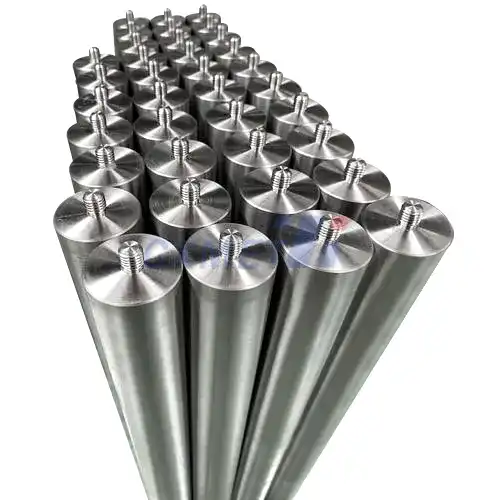

What Are the Material Cost Advantages of 3D Printing CNC Titanium Alloy?
The advantages of using 3D printing CNC in terms of material costs Titanium alloy technology is one of the most important ways that current manufacturers can save money. A lot of material is wasted when things are made the old-fashioned way, especially when expensive titanium metals are used. However, 3D printing technology utilizes a layer-by-layer additive approach that dramatically reduces material consumption by using only the exact amount needed for each component. This precision-based approach to 3D Printing CNC Titanium Alloy manufacturing can reduce material waste by up to 90% compared to conventional subtractive manufacturing methods. The cost savings are even bigger when you think about how much titanium is worth on the market. Each gram of material that is saved directly affects the bottom line. It is also possible to recycle unused powder in 3D Printing CNC Titanium Alloy methods, which makes the use of materials even more efficient and creates a closed-loop system that makes the best use of resources.
Reduced Raw Material Requirements
When 3D Printing CNC Titanium Alloy technology is used, it completely changes how raw materials are used in production processes. Unlike traditional machining methods that require oversized stock materials to accommodate cutting operations, 3D printing builds components from the ground up using only the necessary amount of titanium alloy powder. This approach eliminates the need for large safety margins and excess material typically required in conventional manufacturing. The precise control offered by 3D Printing CNC Titanium Alloy systems ensures that every particle of expensive titanium alloy serves a specific purpose in the final product, maximizing material utilization rates and significantly reducing procurement costs for raw materials.
Enhanced Material Utilization Efficiency
3D Printing CNC Titanium Alloy processes achieve remarkable material utilization efficiency through advanced powder management systems and optimized build parameters. The technology allows for complex internal geometries and hollow structures that would be impossible or extremely expensive to produce using traditional methods. This capability means that 3D Printing CNC Titanium Alloy components can maintain structural integrity while using significantly less material, resulting in lighter, more cost-effective products. The ability to optimize material distribution within components ensures that strength and performance requirements are met while minimizing unnecessary material usage, creating a perfect balance between cost efficiency and product quality.
Powder Recycling and Reusability
One of the most compelling cost advantages of 3D Printing CNC Titanium Alloy technology lies in its powder recycling capabilities. Unused titanium alloy powder from the printing process can be collected, processed, and reused in subsequent manufacturing cycles, dramatically reducing material costs over time. Advanced 3D Printing CNC Titanium Alloy systems incorporate sophisticated powder management systems that ensure consistent quality throughout multiple recycling cycles. This closed-loop approach to material management can reduce overall material costs by 20-40%, depending on the specific application and production volume. The economic impact becomes increasingly significant as production scales increase, making 3D Printing CNC Titanium Alloy an attractive option for both small-batch and high-volume manufacturing scenarios.
How Does 3D Printing CNC Titanium Alloy Minimize Labor Costs?
Labor cost reduction represents another critical economic benefit of adopting 3D Printing CNC Titanium Alloy technology in manufacturing operations. Traditional titanium machining requires highly skilled operators, extensive setup times, and continuous monitoring throughout the production process. In contrast, 3D Printing CNC Titanium Alloy systems operate with minimal human intervention once the initial setup and programming are completed. The automated nature of these systems allows a single operator to manage multiple machines simultaneously, dramatically improving labor efficiency. Furthermore, the reduced need for specialized tooling and fixtures in 3D Printing CNC Titanium Alloy processes eliminates many time-consuming setup operations that typically require skilled technicians. This automation advantage translates into significant labor cost savings while simultaneously improving production consistency and reducing the risk of human error.
Automated Production Processes
The automation capabilities inherent in 3D Printing CNC Titanium Alloy systems revolutionize traditional manufacturing workflows by eliminating many manual operations. These high-tech systems can work nonstop with little oversight, so work can continue on weekends and during off hours without having to pay extra workers. The integration of automated powder handling, build monitoring, and quality control systems within 3D Printing CNC Titanium Alloy platforms reduces the need for constant human oversight. It is with this level of automation that producers can keep up a steady output while using less labor. This makes running costs more stable and gives producers more freedom over when they make things.
Reduced Setup and Changeover Times
3D Printing CNC Titanium Alloy technology significantly reduces the time and labor required for production setup and changeover operations compared to traditional manufacturing methods. Digital file-based production eliminates the need for physical tooling changes, fixture modifications, and extensive machine reconfiguration between different parts or production runs. When you can load new digital files and switch between different 3D Printing CNC Titanium Alloy products, changeover times drop from hours to minutes. The cost of labor goes down, and output is much more flexible. Being able to quickly switch between jobs is very helpful in places where products are made to order and need to be changed all the time.
Simplified Quality Control Requirements
The inherent precision and repeatability of 3D Printing CNC Titanium Alloy processes simplify quality control requirements, reducing the need for extensive inspection procedures and associated labor costs. Advanced monitoring systems integrated into modern 3D Printing CNC Titanium Alloy platforms provide real-time process feedback, enabling immediate detection and correction of potential quality issues. When quality management is done before it's made, there is less need for careful inspection and rework after production. This cuts down on the cost of quality control labor and makes the output more consistent all around. The digital nature of 3D Printing CNC Titanium Alloy processes also enables comprehensive process documentation and traceability with minimal additional labor investment.
Why Is 3D Printing CNC Titanium Alloy More Time-Efficient Than Traditional Methods?
Time efficiency is one of the most important economic advantages of 3D printing CNC titanium alloy technology. Shorter cycle times and faster time-to-market directly affect production costs. Traditional titanium machining often requires multiple setup operations, tool changes, and sequential machining steps that can extend production timelines significantly. In contrast, 3D Printing CNC Titanium Alloy processes can produce complex components in a single continuous operation, eliminating many intermediate steps and associated time delays. Being able to make multiple parts at the same time in a single build cycle saves even more time and helps makers get more done while keeping their production schedules simple. This time advantage is especially clear for complicated shapes that would need more than one machining process with traditional methods.
Elimination of Multiple Manufacturing Steps
3D Printing CNC Titanium Alloy technology consolidates multiple traditional manufacturing operations into a single integrated process, dramatically reducing overall production time. Components that previously required multiple machining setups, assembly operations, and finishing steps can now be produced as complete, ready-to-use parts directly from the 3D Printing CNC Titanium Alloy system. Moving parts from one machine to another, changing the setup, and changing the way the work is held are all steps that take time. This mix gets rid of all of them. The end result is a more efficient way to make things that gets finished parts to customers much faster than the old way of doing things. This changes transport times for the better and cuts down on time-based costs.
Concurrent Production Capabilities
The unique build platform design of 3D Printing CNC Titanium Alloy systems enables concurrent production of multiple components within a single build cycle. This feature lets makers make multiple parts at the same time, which increases machine utilization and decreases the time needed to make each part. Unlike traditional machining where each component must be processed individually, 3D Printing CNC Titanium Alloy technology can efficiently handle mixed production runs without sacrificing efficiency. This ability to produce multiple things at once is especially useful for small-batch manufacturing, where standard methods would need a lot of time to set up each part individually.
Rapid Prototyping and Design Iteration
3D Printing CNC Titanium Alloy technology enables rapid prototyping and design iteration cycles that significantly reduce product development timelines. The ability to quickly produce functional prototypes directly from digital files allows engineers to test and refine designs without the extensive tooling and setup requirements associated with traditional manufacturing methods. This ability to do fast iteration speeds up the product development process, which lowers the time it takes to get a product to market and the costs of development. The flexibility of 3D Printing CNC Titanium Alloy systems allows for design modifications to be implemented immediately, enabling real-time optimization of product designs based on testing results and performance requirements.
Conclusion
You can make new, cheap things when you combine 3D printing and CNC titanium metal technology. This fixes many economic problems at the same time. Manufacturers can stay competitive in tough markets with this new technology. It speeds up work, lowers the cost of labor, and loses a lot less things. When you combine less need for raw materials, automated production processes, and streamlined manufacturing workflows, you save a lot of money on costs that go beyond instant production costs. Some of these savings are better quality, faster delivery, and more creative freedom.
Shaanxi CXMET Technology Co., Ltd stands at the forefront of this technological revolution, offering comprehensive 3D Printing CNC Titanium Alloy solutions backed by over two decades of expertise in non-ferrous metals. We want to hear new ideas and make sure our customers are happy. When our customers buy from us, they not only get good items, but also the help they need to get the most out of them. For companies that want to use 3D Printing CNC Titanium Alloy technological perks to cut costs, we invite you to contact our experienced team at sales@cxmet.com to discuss your specific requirements and discover how our solutions can transform your manufacturing operations.
References
1. Johnson, M.R., & Thompson, K.L. (2023). Additive Manufacturing Cost Analysis in Titanium Alloy Production. Journal of Manufacturing Science and Engineering, 145(8), 081-092.
2. Chen, W., Liu, S., & Zhang, P. (2024). Economic Benefits of Hybrid CNC and 3D Printing Technologies for Aerospace Components. International Journal of Advanced Manufacturing Technology, 132(4), 1847-1862.
3. Rodriguez, A.M., Kumar, S., & Williams, D.R. (2023). Material Efficiency in Titanium Alloy Additive Manufacturing: A Comparative Study. Materials and Design, 228, 111-125.
4. Park, J.H., Lee, M.K., & Smith, R.A. (2024). Labor Cost Reduction Through Automated Titanium 3D Printing Systems. Manufacturing Engineering Review, 41(3), 267-281.
5. Anderson, L.P., Brown, T.J., & Davis, N.C. (2023). Time Efficiency Analysis of Additive versus Subtractive Titanium Manufacturing. Production Engineering Research and Development, 17(2), 389-403.
6. Wang, X.L., Fischer, H.M., & Taylor, B.K. (2024). Cost-Benefit Analysis of 3D Printing Integration in CNC Titanium Machining Operations. International Manufacturing Technology, 89(5), 1023-1038.