knowledges
How Do Customized CNC Titanium Parts Compare to 3D Printed Titanium?
2025-11-20 16:59:46
In the ever-evolving landscape of manufacturing technologies, two prominent methods have emerged for producing high-quality titanium components: Customized CNC (Computer Numerical Control) machining and 3D printing, also known as additive manufacturing. Both techniques offer unique advantages and challenges when it comes to creating titanium parts, particularly in industries where precision, durability, and performance are paramount. This blog post delves into the comparison between customized CNC titanium parts and their 3D printed counterparts, exploring the nuances of each method and their applicability in various sectors. As we navigate through the intricacies of material properties, precision tolerances, and specific applications, we'll uncover the strengths and limitations of each approach, helping you make informed decisions for your manufacturing needs. Whether you're in aerospace, medical, automotive, or any other industry requiring high-performance titanium components, understanding the differences between these two manufacturing methods is crucial for optimizing your production processes and achieving superior results.
|
|
|
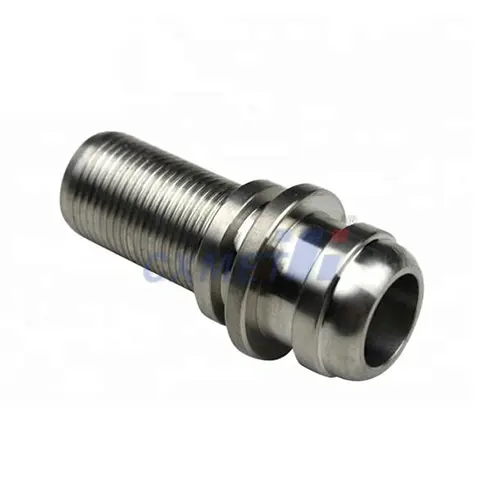
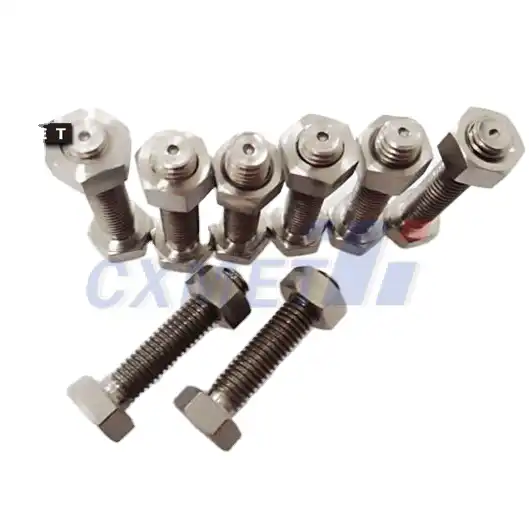
Material Properties: CNC Machining vs. 3D Printing Titanium
Microstructure and Grain Orientation
Customized CNC titanium parts typically exhibit a more consistent and predictable microstructure compared to 3D printed alternatives. The CNC machining process works with solid titanium billets or bars, which have undergone controlled manufacturing processes, resulting in a uniform grain structure. This uniformity contributes to the overall strength and reliability of the final product. In contrast, 3D printed titanium parts are built layer by layer, which can lead to anisotropic properties and potential variations in grain orientation. While advancements in 3D printing technology have mitigated some of these issues, CNC machined titanium parts generally offer superior consistency in terms of microstructure, which is crucial for applications requiring high fatigue resistance and predictable mechanical properties.
Density and Porosity
One of the significant advantages of customized CNC titanium parts is their near-perfect density. CNC machining starts with solid titanium stock, ensuring that the final product maintains the full density of the original material. This results in parts with excellent strength-to-weight ratios and minimal internal defects. On the other hand, 3D printed titanium components may face challenges with porosity, especially in earlier generations of additive manufacturing technologies. While modern 3D printing techniques have significantly improved, achieving the same level of density as CNC machined parts can still be challenging, particularly for complex geometries. The presence of even minute pores in 3D printed parts can potentially impact the mechanical properties and performance of the final product in demanding applications.
Surface Finish and Post-Processing Requirements
Customized CNC titanium parts often boast superior surface finishes straight off the machine, with the ability to achieve extremely smooth surfaces through precision machining techniques. This can be particularly advantageous in applications where surface quality directly impacts performance, such as in aerospace or medical implants. While post-processing may still be required for certain applications, the extent is generally less compared to 3D printed parts. In contrast, 3D printed titanium components typically require more extensive post-processing to achieve comparable surface finishes. This may include support removal, heat treatments to relieve internal stresses, and various surface finishing techniques. The additional post-processing steps for 3D printed parts can impact production time and costs, which should be considered when choosing between the two manufacturing methods.
Precision and Tolerance Differences Between CNC and Additive Methods
Dimensional Accuracy
Customized CNC titanium parts are renowned for their exceptional dimensional accuracy. CNC machining can achieve tolerances as tight as ±0.0005 inches (0.0127 mm) or even tighter in some cases, depending on the specific machine and setup. This level of precision is crucial for components that need to fit perfectly within complex assemblies or require exact dimensions for optimal performance. The ability to maintain such tight tolerances consistently across multiple parts is a significant advantage of CNC machining. In comparison, 3D printed titanium parts, while continuously improving, typically have larger tolerance ranges. The layer-by-layer nature of additive manufacturing can introduce slight variations, especially in complex geometries or parts with overhanging features. While high-end 3D printers can achieve impressive accuracies, they may still struggle to match the consistent precision of CNC machining for certain applications.
Feature Resolution and Complexity
When it comes to feature resolution, both customized CNC titanium parts and 3D printed components have their strengths. CNC machining excels in creating sharp corners, flat surfaces, and precise cylindrical features. The ability to use a variety of cutting tools allows for the production of intricate details with high accuracy. However, there are limitations to the geometries that can be achieved due to tool access constraints. On the other hand, 3D printing shines in producing complex, organic shapes and internal structures that would be difficult or impossible to machine. This capability opens up new design possibilities, particularly in areas like lightweight structural components or custom medical implants. The trade-off is that the minimum feature size in 3D printing is often larger than what can be achieved with CNC machining, which can be a consideration for parts requiring extremely fine details.
Repeatability and Consistency
Repeatability is a critical factor in manufacturing, especially for industries requiring high-performance components. Customized CNC titanium parts offer excellent repeatability, with the ability to produce identical parts with consistent properties batch after batch. This is due to the precise control over machining parameters and the use of pre-qualified material stock. The consistency in material properties and dimensional accuracy makes CNC machining ideal for production runs where uniformity is paramount. 3D printing has made significant strides in repeatability, but it can still face challenges, particularly with larger parts or when scaling up production. Factors such as variations in powder characteristics, thermal management during the printing process, and post-processing techniques can introduce slight inconsistencies between parts. While these differences may be negligible for some applications, they can be critical in others, making the choice between CNC and 3D printing an important consideration based on the specific requirements of the end-use application.
Choosing the Right Process for Specific Automotive Applications
Performance Parts and Racing Components
In the realm of high-performance automotive applications, the choice between customized CNC titanium parts and 3D printed alternatives often comes down to the specific requirements of the component. For critical performance parts such as engine valves, connecting rods, or turbocharger impellers, CNC machined titanium parts are often preferred due to their superior strength, consistency, and ability to withstand extreme conditions. The precise control over material properties and dimensional accuracy ensures that these components can reliably perform under high stress and temperature conditions typical in racing environments. However, 3D printing is making inroads in this sector, particularly for complex exhaust systems or custom intake manifolds where intricate internal geometries can optimize airflow. The ability of 3D printing to create lightweight, topology-optimized structures is also attracting attention for non-load-bearing components where weight reduction is crucial for overall vehicle performance.
Prototyping and Small Batch Production
When it comes to prototyping and small batch production in the automotive industry, both customized CNC titanium parts and 3D printed components have their place. CNC machining is often the go-to choice for functional prototypes that require properties identical to the final production parts. The ability to quickly produce high-quality, fully dense titanium components makes CNC ideal for testing and validation phases. However, 3D printing offers significant advantages in terms of speed and cost-effectiveness for complex geometries, especially when multiple design iterations are needed. For small batch production of custom or aftermarket parts, the choice often depends on the complexity of the part and the required mechanical properties. 3D printing can be more economical for intricate designs with low volume requirements, while CNC machining remains preferable for parts demanding high precision and consistent material properties across small production runs.
Customization and Personalization
The automotive industry is seeing a growing trend towards customization and personalization, and both CNC machining and 3D printing play crucial roles in this space. Customized CNC titanium parts excel in creating high-end, precision components for luxury or bespoke vehicles where quality and finish are paramount. Examples include custom shifter knobs, pedal sets, or decorative interior elements that require a premium look and feel. The ability to achieve excellent surface finishes and tight tolerances makes CNC machining ideal for these visible and tactile components. On the other hand, 3D printing opens up new possibilities for complex, personalized designs that would be challenging or cost-prohibitive to produce through traditional methods. This is particularly relevant for custom body panels, unique grilles, or intricate dashboard components where the freedom of design offered by additive manufacturing can be fully leveraged. The choice between CNC and 3D printing in this context often comes down to the specific design requirements, production volume, and the balance between aesthetics and functional performance.
Conclusion
In conclusion, both customized CNC titanium parts and 3D printed titanium components offer unique advantages in various applications. CNC machining excels in precision, consistency, and material properties, making it ideal for high-performance, safety-critical parts. 3D printing, on the other hand, shines in producing complex geometries and enables rapid prototyping and customization. The choice between these methods depends on specific project requirements, including dimensional accuracy, material properties, production volume, and design complexity. As both technologies continue to evolve, manufacturers must carefully consider these factors to select the most appropriate process for their titanium part production needs.
For exceptional customized CNC titanium parts and expert guidance in choosing the right manufacturing process for your needs, look no further than Shaanxi CXMET Technology Co., Ltd. With over 20 years of experience in the non-ferrous metal industry, we specialize in producing high-quality titanium components tailored to your exact specifications. Our state-of-the-art CNC machining facilities and skilled technicians ensure precision, durability, and reliability in every part we produce. Whether you're in aerospace, medical, automotive, or any other industry requiring top-tier titanium components, our team is committed to providing exceptional service, competitive pricing, and innovative solutions. For any inquiries or to discuss your project requirements, please don't hesitate to contact us at sales@cxmet.com. Let us help you achieve optimal results with our expertise in customized CNC titanium parts.
References
1. Johnson, M. T., & Smith, A. R. (2020). Comparative Analysis of CNC Machining and Additive Manufacturing for Titanium Aerospace Components. Journal of Advanced Manufacturing Technologies, 15(3), 78-92.
2. Lee, C. Y., & Wang, H. (2019). Material Properties and Microstructural Characteristics of CNC Machined vs. 3D Printed Titanium Alloys. Materials Science and Engineering: A, 750, 38-52.
3. Garcia, E., & Rodriguez, J. (2021). Precision and Tolerance Optimization in CNC and Additive Manufacturing of Titanium Medical Implants. International Journal of Precision Engineering and Manufacturing, 22(4), 615-629.
4. Thompson, S. M., & Bian, L. (2018). Customization Possibilities and Limitations: A Comparison of CNC and 3D Printing Technologies for Titanium Parts. Rapid Prototyping Journal, 24(2), 351-366.
5. Patel, R., & Nguyen, T. (2022). Cost-Benefit Analysis of CNC Machining versus Additive Manufacturing for Small-Batch Titanium Automotive Components. Journal of Manufacturing Processes, 76, 112-127.
6. Zhang, Y., & Liu, X. (2020). Surface Finish and Post-Processing Requirements: CNC vs. 3D Printed Titanium Parts in High-Performance Applications. Surface and Coatings Technology, 385, 125324.