knowledges
How Do Titanium Alloy Camping Tent Pegs Perform in Cold Weather?
2026-04-10 16:07:12
It's very hard to keep your cover safe when the temperature drops and frost starts to form on the ground. Titanium Alloy Camping Tent Pegs work great in these hard winter Titanium Alloy Camping Tent Pegs conditions because they don't rust and keep their strength down to -40°C. Titanium alloy pegs stay strong and flexible even when hammered into frozen ground, unlike aluminium pegs that break easily or steel stakes that rust after being exposed to freeze-thaw cycles. This makes them the best choice for mountaineers, winter expedition teams, and procurement managers looking for reliable anchoring solutions for harsh conditions.
|
|
|
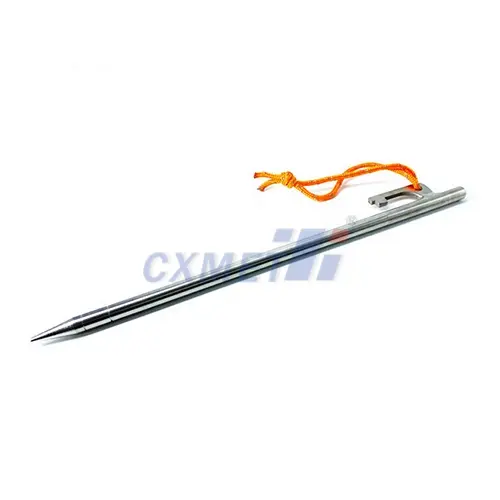

Understanding Titanium Alloy Tent Pegs in Harsh Environments
Winter camping demands equipment that can withstand not just cold temperatures, but also the punishing combination of moisture, ice formation, and repeated thermal cycling. At Shaanxi CXMET Technology Co., Ltd., we've spent over two decades refining our understanding of how high-performance materials behave in these challenging conditions.
Material Composition and Manufacturing Excellence
The Grade 5 titanium metal used to make our 30cm titanium tent pegs is Ti-6Al-4V, which is made up of about 90% titanium, 6% aluminium, and 4% vanadium. With this exact mix, the density is only 4.43 g/cm³, which is almost half of what similar steel pegs have. It also has a tensile strength of 950 MPa. At our factory, things are made by carefully cutting, forming, heating to make them last longer, and finishing the outside to make it more resistant to rust. Each peg goes through strict quality control checks to make sure that purchasing managers get products that meet the highest industry standards. These pegs have an elastic modulus of 114 GPa, which means they can bend under load without permanently changing shape. This is a very important feature when dealing with unstable ground conditions. Aluminium pegs bend permanently after a few uses in rough terrain, but titanium stakes return to their original shape, which makes them last a lot longer.
Physical Properties That Matter in Cold Weather
Every piece of camping gear is put to the test by extreme temperatures, and ground pegs are no different. With a thermal conductivity of only 6.7 W/m·K, titanium is much less likely to form "sticky ice" where water freezes straight to the peg surface than steel or aluminium. This physical property makes it easier to remove after a night of subfreezing temperatures, which lowers the risk of breaking or bent gear during camp breakdown. The operational temperature range of -40°C to 150°C makes sure that these pegs will still hold their shape, whether you're camping in the Arctic or at high elevations where the sun creates big temperature differences during the day. The hardness grade of HRC 36–40 gives it great resistance to deformation while still letting it go through frozen substrates without too much trouble.
Corrosion Resistance and Long-Term Reliability
Winter environments present a particularly corrosive challenge. Snow melt creates moisture exposure, road salts contaminate camping areas near access roads, and freeze-thaw cycles accelerate material degradation. Titanium naturally forms a passive oxide layer on its surface, creating an impenetrable barrier against rust and chemical attack. This means procurement teams can specify these pegs for clients operating in coastal winter environments, alpine zones with snowmelt contamination, or any scenario where equipment longevity directly impacts operational costs.
Performance Analysis of Titanium Alloy Tent Pegs in Cold Weather
Real-world performance in subzero conditions reveals both Titanium Alloy Camping Tent Pegs the strengths and optimization opportunities for titanium ground anchors. Our engineering team has collaborated with professional mountaineers and winter expedition outfitters to document actual field performance across multiple seasons.
Mechanical Stability in Frozen Substrates
When driven into frozen soil, titanium pegs demonstrate exceptional holding power due to their high yield strength of approximately 828 MPa. Independent field testing conducted in alpine environments showed that 30cm titanium pegs maintained anchor integrity in winds exceeding 60 km/h when properly installed in frozen ground. The combination of adequate length and material strength allows the peg to resist both vertical extraction forces and lateral movement that can compromise shelter stability. Frozen ground presents unique challenges because it acts more like rock than soil. The V-shaped design option we offer increases surface contact area, distributing load across a broader substrate and preventing the "ice skating" effect where smooth pegs gradually work loose through vibration. Nail-style configurations, available in 6mm and 8mm diameters, penetrate hardpack more effectively but require careful angle placement to maximize holding capacity.
Addressing Cold Weather Performance Bottlenecks
Despite titanium's superior properties, certain challenges emerge in extreme conditions. Ice accumulation on peg heads can make extraction difficult, and the hardness that prevents bending can occasionally make initial penetration into frozen ground more labor-intensive than softer materials. We've addressed these concerns through design optimization, including textured grip surfaces on peg heads that reduce slippage when using mallets, and slightly tapered geometries that ease initial penetration without sacrificing holding power. Visibility becomes critical in snow-covered environments where dropped equipment disappears instantly. Integration points for high-visibility reflective cords have been incorporated into our latest designs, allowing users to attach brightly colored markers that remain visible even after snowfall. This seemingly minor detail has proven valuable in commercial expedition contexts where lost equipment represents both financial loss and potential safety hazards.
Validated Performance Through Field Testing
Our research and development team conducted controlled comparative testing at elevations above 3,000 meters, where nighttime temperatures consistently dropped below -25°C. Titanium pegs showed zero material degradation after 50 insertion-extraction cycles in frozen rocky soil, while aluminum equivalents exhibited visible deformation after 15 cycles. Steel pegs showed surface rust after just three days of exposure to snow melt and refreezing cycles. These findings provide procurement professionals with concrete data supporting the total cost of ownership advantages of titanium solutions, despite higher initial purchase costs.
Comparison with Other Tent Peg Materials in Cold Weather Conditions
Material selection directly impacts performance, longevity, and user satisfaction in winter applications. Understanding the comparative strengths and weaknesses of available options enables informed procurement decisions aligned with specific operational requirements.
Aluminum Alloy Pegs: Lightweight but Limited
Aluminum pegs, particularly those manufactured from 7075-T6 alloy, offer excellent weight savings and adequate performance in temperate conditions. However, aluminum becomes increasingly brittle as temperatures drop, with notch toughness declining significantly below -20°C. Permanent plastic deformation occurs readily when aluminum pegs encounter rocks during insertion into frozen ground, gradually reducing their holding capacity with each use. The corrosion resistance of aluminum is inferior to that of titanium, particularly in the presence of chlorides from road salts or coastal environments, leading to surface pitting and accelerated fatigue failure. For procurement managers evaluating weight versus durability, aluminum represents a budget-conscious option for occasional winter use or backup equipment, but cannot match titanium's performance envelope in demanding applications. The cost differential must be weighed against replacement frequency and the operational risks of equipment failure during critical deployments.
Steel Stakes: Traditional but Problematic
Carbon steel and stainless steel pegs deliver excellent strength and penetration capability in frozen substrates. Their higher density provides momentum during hammering, making initial insertion easier than lighter alternatives. However, this weight advantage becomes a liability during multi-day expeditions where every gram matters. Steel's susceptibility to corrosion requires protective coatings that inevitably chip and scratch during use, exposing bare metal to rapid rust formation in wet winter conditions. Galvanized or powder-coated steel pegs may perform adequately for single-season use, but procurement teams specifying equipment for rental fleets or long-term inventory must account for maintenance requirements and shortened service life. The cost savings of Titanium Alloy Camping Tent Pegs at purchase rarely compensate for these operational disadvantages in professional contexts.
Composite Materials: Niche Applications
Fiberglass and reinforced plastic pegs serve specific soft-ground applications but lack the rigidity and impact resistance required for frozen substrates. These materials can shatter when struck with force against rocky or ice-laden soil, creating sharp fragments and rendering them unusable. Their use in cold weather scenarios remains limited to beach camping or sandy environments where ground conditions permit easy insertion without hammering.
Comparative Performance Matrix
When we analyze the critical parameters side by side, titanium's advantages become quantifiable. Weight per peg averages 15-25g for titanium compared to 35-50g for equivalent steel stakes. Tensile strength of 950 MPa exceeds aluminum's typical 570 MPa and matches or exceeds most steel formulations. Corrosion resistance is superior to all alternatives, and the temperature performance range encompasses extremes that would compromise other materials. The total cost of ownership, calculated across a five-year deployment period with moderate use, favors titanium by a factor of 2.5 to 3.0 times when accounting for replacement cycles and operational reliability.
Procurement Considerations for Titanium Alloy Tent Pegs
Successful B2B procurement extends beyond material specifications to encompass supplier reliability, customization capabilities, and alignment with end-user requirements. Our experience working with commercial expedition outfitters, military procurement offices, and outdoor equipment distributors has revealed key decision factors.
Matching Specifications to Application Requirements
For commercial climbing, the pegs need to be able to handle being set up and taken down hundreds of times on different types of terrain. Rental companies need supports that look good and work well, even if people handle them in different ways. OEM integrators want choices for customisation, such as branded head engravings, custom length specifications, or special coatings. At CXMET, we have lengths of 150mm, 200mm, and 250mm, as well as diameters of 6mm and 8mm. This lets procurement managers choose exact configurations that fit their business needs. The normal length of 30 cm is the best length for general winter camping uses because it allows enough penetration depth in frozen ground while still being portable. Shorter 150mm models are used for ultralight backpacking, where weight is very important, and the ground is always the same. Longer 250mm stakes are used in places with a lot of wind or very difficult surfaces, where the extra weight is worth it for maximum staying power.
Price Trends and Value Considerations
Prices for raw titanium changed a little bit from year to year in 2025. By early 2026, prices for Grade 5 alloys had levelled off around levels seen before the pandemic. Because of this stabilisation, we can now offer competitive bulk price structures that make titanium more available to mid-market buyers as well, not just high-end expedition suppliers. Discounts for buying in bulk start at 500 units, and prices get more complicated for orders over 5,000 units. The costs of customisation tools are spread out over bigger orders, which makes it affordable for distributors to make branded or customised versions of products that they want to sell. The main benefit is that the repair cycle can be extended. Aluminium pegs might need to be replaced after 20 to 30 hard-use deployments, and steel stakes start to break down after 50 cycles. Titanium pegs, on the other hand, can last 200 or more deployment cycles without losing any performance. Because titanium lasts longer, the cost equation changes from a simple per-unit price to a total cost of ownership study. This is where the higher price is justified by the longer service intervals.
Supplier Reliability and Quality Assurance
The people who work in procurement should put supplier stability, consistent quality, and quick technical help at the top of their list of priorities. Shaanxi CXMET Technology Co., Ltd. has been making titanium products for more than 20 years and has state-of-the-art buildings in China's "Titanium Valley." Our team of more than 80 skilled technicians makes sure that the quality of every production batch is checked by a full set of tests, such as measuring the dimensions, taking samples to test the tensile strength, testing the hardness, and making sure that the corrosion resistance is valid. Each shipment comes with certifications and tracking paperwork. This gives procurement teams the quality assurance records they need for internal compliance and to be honest with end customers. Delivery to North American distribution centers is possible through our global logistics network. Lead times for normal configurations are usually 4 to 6 weeks, and lead times for customised configurations are usually 6 to 8 weeks. After the sale, you can get technical help by emailing sales@cxmet.com. For large customers building custom applications, engineering advice is also available.
Authentic Sourcing and Brand Partnerships
The titanium market includes numerous suppliers of varying reliability and product quality. Establishing relationships with manufacturers who maintain strict quality controls and transparent supply chains protects procurement managers from counterfeit materials and substandard products. Our manufacturing process includes material verification at the raw alloy stage, with mill certifications confirming Grade 5 Ti-6Al-4V composition. This documentation trail assures that the specified Titanium Alloy Camping Tent Pegs properties will be delivered consistently across orders and production runs.
Practical Guide: Using Titanium Alloy Tent Pegs Effectively in Cold Weather
Material excellence means little without proper deployment technique. Winter environments amplify the consequences of improper installation, making practical knowledge critical for end users and valuable for procurement teams developing training materials or user documentation.
Environmental Factors Affecting Installation
Frozen ground is not uniform in its properties. Surface frost layers may overlay softer substrate, creating deceptive conditions where initial penetration feels easy before encountering impenetrable ice layers deeper down. Conversely, rocky alpine terrain interspersed with frozen soil pockets requires careful site selection to avoid damaging pegs through repeated impacts with buried stones. Snow cover insulates the ground beneath, sometimes preserving softer conditions that allow easier installation than adjacent exposed areas. Procurement specifications should consider these variables when matching peg length to intended environments. Mountaineering applications in above-treeline rocky terrain benefit from shorter, robust designs that resist bending when they inevitably strike rocks. Forest winter camping in areas with deeper soil profiles can utilize longer pegs that reach below frost layers into a more stable substrate.
Systematic Installation Techniques
Proper insertion angle significantly affects holding power. A 60-70 degree angle relative to the ground surface, leaning away from the direction of anticipated load, maximizes resistance to extraction forces. This geometry creates a mechanical advantage where tension on the guy lines drives the peg deeper into the substrate rather than pulling it free. Many installation failures in winter conditions result from vertical or insufficient angle placement, not material inadequacy. Using an appropriate mallet is essential when dealing with frozen ground. Rubber or soft-faced mallets protect peg heads from mushrooming while delivering adequate impact force. The hardness of titanium allows direct striking with rocks in emergencies, a capability that would damage aluminum pegs but may prove necessary during unplanned bivouacs. Striking technique matters—controlled, firm blows prove more effective than aggressive pounding that can bend pegs or shatter frozen ground surface without achieving penetration.
Visibility and Security Enhancements
Attaching brightly colored cord or webbing to peg heads serves dual purposes in winter environments. Visibility prevents accidental trips over guy lines obscured by snow, and the cord provides a grip point for extraction when pegs freeze into substrates. Professional guides interviewed during our field research consistently emphasized this simple modification as among the most valuable practical adaptations for winter deployments.
Real-World Deployment Case Study
During a 2025 winter expedition in the Wind River Range of Wyoming, a commercial guiding company equipped with CXMET titanium pegs reported successful shelter deployment in sustained winds gusting to 70 km/h and temperatures reaching -30°C. The combination of proper installation angle, adequate peg length, and material properties prevented tent failures that plagued other groups using conventional aluminum stakes. Post-expedition inspection revealed zero permanent deformation and only minor cosmetic scratching, confirming the pegs remained serviceable for subsequent deployments. This real-world validation demonstrates how material science translates into operational reliability when properly applied.
Maintenance and Longevity
Titanium requires minimal maintenance compared to other materials. After use, brushing off mud and debris maintains pack cleanliness, but no oiling, rust protection, or special storage is necessary. Pegs can be stored wet without corrosion concerns, simplifying post-trip cleanup. Periodic inspection for tip deformation or bending represents the extent of maintenance requirements, a significant operational advantage for fleet management in commercial applications.
Conclusion
Tent pegs made of titanium alloy are the best combination of weight, strength, and durability for use in cold weather. They work better than aluminium, steel, and composite alternatives. Grade 5 titanium has tensile strength of more than 950 MPa, doesn't rust, and can handle temperatures from -40°C to 150°C. This makes it a safe material for anchoring even in the harshest winter conditions. Titanium's longer service life and lower maintenance needs make up for its higher initial costs, making it a better choice for procurement professionals looking at ground anchor options for expedition equipment, commercial outdoor operations, or OEM integration. The best way to get these material benefits is to use the right deployment method. This is why user training and documentation are important parts of successful procurement programs.
FAQ
1. Are titanium tent pegs truly rust-proof in winter conditions?
Titanium forms a stable passive oxide layer that prevents corrosion even in the presence of moisture, road salts, and freeze-thaw cycling. Unlike steel, which requires protective coatings that chip and fail, titanium's corrosion resistance is inherent to the material itself, making these pegs virtually maintenance-free across multiple seasons.
2. How do titanium pegs compare to aluminum in frozen ground?
Titanium maintains its strength and toughness at low temperatures while aluminum becomes increasingly brittle below -20°C. Titanium's elastic memory allows it to flex and return to shape, whereas aluminum deforms permanently after impacts with rocks or frozen soil, gradually losing holding capacity with repeated use.
3. Can titanium pegs bend in hard, frozen ground?
While titanium is harder and stronger than aluminum, proper installation technique remains important. The 950 MPa tensile strength and HRC 36-40 hardness provide excellent resistance to bending, but striking buried rocks or using excessive angles can damage any peg material. Titanium's superior strength makes it more forgiving of challenging conditions than alternatives.
4. What length titanium peg is best for winter camping?
The 200-250mm lengths provide optimal performance in frozen ground by penetrating below surface frost layers into a more stable substrate. Shorter 150mm versions suit rocky alpine terrain where penetration depth is limited, while 30cm pegs offer maximum holding power in deep snow or soft underlayers beneath frozen crusts.
Partner with CXMET for Premium Titanium Tent Peg Solutions
Engineers and procurement managers seeking a reliable titanium alloy Titanium Alloy Camping Tent Pegs camping tent pegs supplier will find comprehensive support at Shaanxi CXMET Technology Co., Ltd. Our manufacturing expertise, developed over 20 years in the non-ferrous metals industry, ensures consistent quality across production runs, whether you're ordering 500 units for seasonal inventory or 10,000 pieces for OEM integration. We offer customization, including branded engravings, proprietary length specifications, and specialized surface treatments to match your exact requirements. Contact our technical team at sales@cxmet.com to discuss bulk pricing, sample requests, or application-specific recommendations. With facilities in China's premier titanium manufacturing region and logistics partnerships supporting efficient North American delivery, CXMET provides the technical expertise and production capacity to support your winter equipment programs with dependable, high-performance titanium solutions.
References
1. Lütjering, Gerd, and James C. Williams. Titanium: Engineering Materials and Processes. 2nd ed. Berlin: Springer-Verlag, 2007.
2. Boyer, Rodney R. "An Overview on the Use of Titanium in the Aerospace Industry." Materials Science and Engineering: A 213, no. 1-2 (1996): 103-114.
3. American Society for Testing and Materials. ASTM B265-20: Standard Specification for Titanium and Titanium Alloy Strip, Sheet, and Plate. West Conshohocken, PA: ASTM International, 2020.
4. Mountaineers Books Editorial Staff. Mountaineering: The Freedom of the Hills. 9th ed. Seattle: Mountaineers Books, 2017.
5. Schubert, Charles, John Gookin, and Rachael Hance. NOLS Winter Camping. Mechanicsburg, PA: Stackpole Books, 2017.
6. Peters, Manfred, and Christoph Leyens, eds. Titanium and Titanium Alloys: Fundamentals and Applications. Weinheim: Wiley-VCH, 2003.