knowledges
How Does Titanium 6Al-4V Grade 5 Round Bar Compare to Grade 2?
2026-04-29 15:06:38
When you look at titanium metals side by side, Grade 5 and Grade 2 are very different from one another. It is an alpha-beta titanium alloy with about 6% aluminium and 4% vanadium. The titanium 6Al-4V Grade 5 Round Bar has a tensile strength of up to 895 MPa and a mass of only 4.43 g/cm³. Grade 2 is commercially pure titanium that doesn't have many alloying elements. It has a tensile strength of about 345 MPa, but it is more flexible and doesn't rust as easily in some acidic titanium 6Al-4V Grade 5 Round Bar situations. This comparison is very important for engineers choosing materials where environmental conditions, mechanical performance, and production needs all come together.
|
|
|
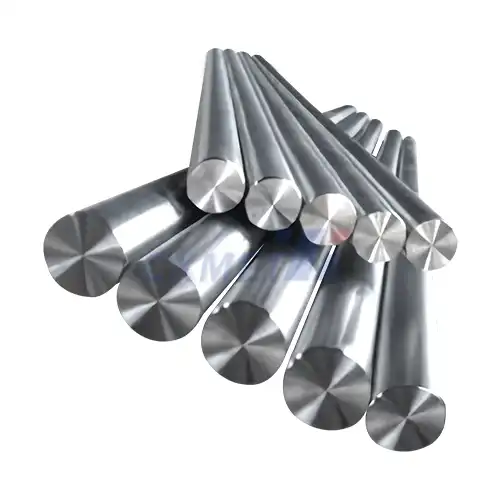

Understanding Titanium 6Al-4V Grade 5 and Grade 2: Composition and Properties
Chemical Composition Breakdown
The main difference between these types of titanium is the chemicals that make them up. As an alpha stabiliser, aluminium is used in Grade 5, which is also called Ti-6Al-4V (UNS R56400), and vanadium is used as a beta stabiliser. These alloying elements make a microstructure with two phases that improves mechanical qualities by a large amount. Grade 2 titanium (UNS R50400), on the other hand, is made up of at least 99.2% pure titanium and small amounts of iron, oxygen, and carbon. Grade 5 aluminium makes the titanium stronger, denser, and more resistant to rusting. Vanadium makes the combination stronger and lets it respond to heat treatment, making it a flexible metal that can be made better through thermal processing. With this compositional approach, Grade 5 can become almost three times as strong as Grade 2, while still having the natural corrosion resistance of titanium.
Mechanical Property Comparison
The difference is instantly clear when judging the performance of a machine. In the annealed state, Grade 5 has a final tensile strength of about 895 MPa and a yield strength of about 828 MPa. These values can be raised even more by solution treating and ageing, which makes it ideal for parts that are under a lot of stress. The tensile strength of Grade 2 is only 345 MPa, and the yield strength is only about 275 MPa. The elongation qualities show another important difference. Grade 2 usually stretches 20%, which shows that it is more flexible and easier to shape. Grade 5 has an extension of about 10 to 14 percent, which is enough for most uses but shows that strength and deformation capacity are not perfectly balanced. Obviously, this difference has a big effect on the making process, especially when cold-forming, where Grade 2's flexibility is very helpful.
Corrosion Resistance Characteristics
Both types create a layer of titanium dioxide that protects against corrosion and works well in most settings. There are, however, some small changes. Because it is purer and doesn't contain any alloying elements that can make galvanic micro-cells, Grade 2 does a little better in reducing acid conditions. The alloy has been tested in highly acidic environments where stainless steel fails. Grade 5 works just as well as Grade 2 in oxidising environments, seawater, and chloride-rich circumstances. The aluminium presence actually makes it more resistant to oxidation at temperatures up to 400°C. We, at Shaanxi CXMET Technology Co., Ltd., have sent Grade 5 round bars to offshore sites that work in the North Sea and the Gulf of Mexico. These bars have stayed strong even though they've been exposed to saltwater and mechanical stress all the time.
Heat Treatment Response
Heat treatment capability represents a decisive advantage for Grade 5. The alloy responds to solution treating (typically at 900-950°C) followed by aging (480-650°C), which can increase strength by 15-20% while slightly reducing ductility. This allows engineers to tailor properties to specific applications. Grade 2, being commercially pure, doesn't exhibit a significant response to heat treatment beyond stress relief annealing. The microstructure of Grade 5 can be manipulated through controlled cooling rates from the beta transus temperature, creating fine or coarse alpha-beta structures depending on desired properties. This metallurgical flexibility enables optimization that simply isn't possible with commercially pure Grade 2.
Performance and Application Differences in Industrial Use
Aerospace and High-Performance Applications
The aerospace industry titanium 6Al-4V Grade 5 Round Bar overwhelmingly prefers Grade 5 for structural components where the strength-to-weight ratio directly impacts fuel efficiency and payload capacity. Landing gear components, fuselage frames, and fasteners manufactured from our Grade 5 round bars have operated reliably in commercial and military aircraft for decades. The alloy's fatigue resistance—critical in cyclic loading scenarios—surpasses Grade 2 by a substantial margin. Medical device manufacturers similarly favor Grade 5 for orthopedic implants, surgical instruments, and dental components. The biocompatibility of titanium combined with Grade 5's mechanical strength makes it ideal for load-bearing implants like hip replacements and spinal fusion hardware. Grade 2 finds use in non-load-bearing medical applications, such as instrument handles or certain prosthetic components, where strength demands are lower.
Marine and Chemical Processing Environments
Marine applications present an interesting decision point. Grade 2's exceptional corrosion resistance and lower cost make it attractive for piping systems, heat exchangers, and vessel linings where structural loads remain moderate. The alloy's formability simplifies the fabrication of complex geometries common in chemical processing equipment. Grade 5 enters the equation when marine components face significant mechanical stress. Propeller shafts, offshore platform structural members, and subsea equipment housings benefit from the alloy's superior strength. We've delivered Grade 5 round bars to petrochemical facilities where components must withstand both corrosive media and substantial mechanical loads—a combination where Grade 2 simply lacks adequate strength margins.
Machining and Fabrication Considerations
Machinability differences significantly impact manufacturing economics. Grade 2's lower strength and work-hardening rate make it substantially easier to machine. Conventional cutting tools and parameters produce acceptable results with reasonable tool life. The material can be cold-formed and welded without excessive difficulty, reducing fabrication costs. Grade 5 demands more sophisticated machining strategies. Low thermal conductivity causes heat accumulation at the cutting interface, necessitating sharp carbide or ceramic tools, reduced cutting speeds, increased feed rates, and copious cooling. The alloy's tendency to gall and work-harden requires careful process control. However, with proper techniques, Grade 5 can be machined to tight tolerances. Our production facility in China Titanium Valley employs CNC equipment specifically configured for titanium alloy processing, ensuring dimensional accuracy within h8-h9 tolerance ranges. Welding both grades requires inert gas shielding to prevent contamination, but Grade 5's higher strength means weld joint design must account for stress concentrations more carefully. TIG and electron beam welding produce sound joints in both materials when proper procedures are followed.
Comparative Analysis: Titanium 6Al-4V Grade 5 vs Other Materials
Grade 5 Versus Grade 23 (Ti-6Al-4V ELI)
Grade 23 represents an "Extra Low Interstitial" version of Grade 5, with tighter controls on oxygen, nitrogen, and iron content. This results in improved fracture toughness and ductility while maintaining similar strength levels. The aerospace and medical sectors specify Grade 23 for cryogenic applications and fracture-critical components where the risk of brittle failure must be minimized. The cost differential between Grade 5 and Grade 23 can reach 20-30%, making Grade 23 a premium choice reserved for applications where its specific properties justify the expense. For most industrial applications, standard Grade 5 provides adequate performance at a better value.
Titanium Grade 5 Against Stainless Steel
Comparing Grade 5 to austenitic stainless steels like 316L reveals titanium's weight advantage. Grade 5 achieves comparable or superior strength at roughly 60% of steel's density. This weight reduction translates directly to fuel savings in transportation applications and easier handling during installation. Corrosion resistance favors titanium in chloride-rich and marine environments, where stainless steel suffers pitting and crevice corrosion. However, stainless steel offers better thermal conductivity, lower material cost, and easier machinability. The selection depends on whether corrosion resistance and weight reduction justify titanium's higher acquisition and fabrication costs.
Performance Against Aluminum Alloys
High-strength aluminum alloys like 7075-T6 approach Grade 2 titanium in specific strength but cannot match Grade 5. Titanium's corrosion resistance vastly exceeds that of aluminum in aggressive environments, and titanium maintains properties at temperatures where aluminum softens. The trade-off involves cost—aluminum remains significantly cheaper—and machinability, where aluminum excels. Automotive racing applications increasingly replace aluminum suspension components with Grade 5 titanium parts. The fatigue resistance and damage tolerance of titanium prevent catastrophic failures common to titanium 6Al-4V Grade 5 Round Bar with aluminum under extreme cyclic loading.
Benchmarking Against Nickel Superalloys
INCONEL and similar nickel-based superalloys outperform Grade 5 at temperatures above 400°C, making them preferred for hot-section gas turbine components. However, nickel alloys weigh substantially more and cost considerably more than titanium. Grade 5 dominates the intermediate temperature range (200-400°C), where aluminum alloys lose strength, but nickel alloys represent economic overkill. The weight difference becomes critical in rotating components where the nickel alloy mass increases centrifugal stresses. Compressor blades and discs frequently use Grade 5 to minimize weight while maintaining adequate high-cycle fatigue resistance.
Procurement Insights: Sourcing Titanium 6Al-4V Grade 5 Round Bar
Current Market Dynamics
Global titanium markets have experienced price fluctuations driven by aerospace demand cycles and raw material availability. Grade 5 round bar pricing typically ranges from $15-30 per kilogram, depending on diameter, quantity, certification requirements, and surface finish specifications. Grade 2 generally costs 10-20% less due to simpler production processes. Minimum order quantities vary by supplier. Large distributors may require 500 kg minimum orders, while manufacturers like Shaanxi CXMET Technology Co., Ltd. offer flexibility for smaller quantities when project requirements demand it. Custom diameters and lengths often carry premium pricing, but eliminate material waste from cutting oversized stock.
Critical Supplier Evaluation Criteria
Certification and traceability matter enormously in titanium procurement. Aerospace and medical applications mandate material test reports (MTR) documenting chemistry, mechanical properties, and heat lot traceability. Compliance with ASTM B348, AMS 4928, and AMS 6931 standards ensures material meets specification requirements. Quality control processes separate reliable suppliers from questionable sources. Ultrasonic inspection detects internal defects invisible to surface examination. Dimensional verification confirms diameter tolerance and straightness. Our facility maintains ISO 9001 certification and employs spectroscopic analysis to verify chemistry on every production lot. Beware of non-conforming material entering supply chains through unscrupulous brokers. Counterfeit test reports and mislabeled alloys have caused equipment failures, resulting in millions of dollars in damage. Establishing relationships with reputable manufacturers provides assurance that the material pedigree is genuine.
Lead Times and Logistics Considerations
Standard diameter Grade 5 round bars (10-100mm) typically ship within 2-4 weeks from established suppliers maintaining inventory. Custom diameters or special processing requirements can extend lead times to 8-12 weeks, depending on production schedules. Planning procurement timelines to accommodate these realities prevents project delay. International shipping introduces additional complexity. Titanium products generally don't face export restrictions, but proper documentation ensures smooth customs clearance. Insurance coverage protects against damage during transit—particularly important given titanium's value. We coordinate logistics through experienced freight forwarders familiar with non-ferrous metal shipments, minimizing complications.
Value-Added Services
Cutting services eliminate waste and reduce handling costs. Suppliers offering precision cutting to length, often with tolerances of ±0.5mm, allow direct integration into manufacturing workflows. Centerless grinding produces round bars with h8 or h9 tolerance and superior surface finish, reducing or eliminating secondary machining operations. Heat treatment services provide another value addition. Suppliers capable of solution treating and aging can deliver material in the optimized condition for specific applications, eliminating the need for customers to develop and control heat treatment of titanium 6Al-4V Grade 5 Round Bar processes in-house.
Making the Right Choice: Grade 5 vs Grade 2 for Your Business Needs
Decision Framework for Material Selection
Selecting between Grade 5 and Grade 2 requires a systematic evaluation of application requirements. Mechanical loading represents the primary consideration. Components experiencing high stress, fatigue loading, or impact demand Grade 5's superior strength. Lightly loaded structures where corrosion resistance drives material selection may find Grade 2 adequate and more economical. The operating environment influences the decision. Both grades perform excellently in marine and moderately corrosive chemical environments. Grade 2's slight advantage in certain reducing acids may tip the balance for chemical processing equipment. Temperature requirements above 150°C favor Grade 5 due to better property retention at elevated temperatures. Budget constraints cannot be ignored. Grade 5's higher material cost plus increased fabrication expenses from difficult machining must be justified by performance requirements. Projects with tight cost targets may accept Grade 2's lower strength to achieve budget objectives, compensating through design modifications like increased wall thickness or additional reinforcement.
Lifecycle Cost Considerations
Initial material cost represents only part of the total ownership economics. Grade 5's superior fatigue resistance extends component service life, potentially doubling replacement intervals compared to Grade 2 in high-cycle applications. Reduced maintenance frequency and longer replacement intervals often justify higher upfront investment. Weight savings from Grade 5's higher specific strength reduce fuel consumption in transportation applications. A commercial aircraft component weighing 40% less than a steel equivalent saves hundreds of dollars in fuel costs annually. Over a 20-year service life, operational savings dwarf material cost differentials. Failure consequences must factor into material decisions. Critical components where failure risks lives or causes catastrophic environmental damage warrant conservative material choices. Grade 5's higher strength and better fracture toughness provide additional safety margins that reduce risk exposure.
Industry-Specific Application Guidance
Aerospace projects almost universally specify Grade 5 for structural applications. The industry's rigorous qualification processes and performance requirements leave little room for Grade 2 except in non-structural applications like fluid lines or secondary structures. Medical device manufacturers choose based on loading conditions. Orthopedic implants bearing body weight require Grade 5's strength. Surgical instruments and non-load-bearing implants can utilize Grade 2, leveraging its superior formability for complex shapes. Marine and offshore applications benefit from case-by-case analysis. Structural components like wellhead equipment and platform members justify Grade 5. Piping systems, heat exchangers, and tanks handling corrosive media often employ Grade 2 economically. We've worked with offshore engineering firms to optimize material specifications across complete facilities, using each grade where its properties provide optimal value. Chemical processing facilities similarly benefit from mixed specifications. Reactor vessels and agitators experiencing mechanical stress and corrosion use Grade 5. Transfer piping and storage tanks utilize Grade 2 where structural demands remain modest.
Conclusion
The choice between titanium 6Al-4V Grade 5 Round Bar and Grade 2 round bars fundamentally depends on application-specific requirements, balancing mechanical performance, environmental conditions, and economic constraints. Titanium 6Al-4V Grade 5 Round Bar delivers an exceptional strength-to-weight ratio, superior fatigue resistance, and heat treatment capability, making it indispensable for aerospace, high-performance automotive, and load-bearing medical applications. Grade 2 offers excellent corrosion resistance, superior formability, and lower cost, positioning it effectively for chemical processing equipment, marine piping systems, and applications where extreme mechanical properties aren't necessary. Understanding these distinctions enables engineers and procurement professionals to specify materials that optimize performance while controlling costs throughout the component lifecycle.
FAQ
1. What represents the primary strength difference between Grade 5 and Grade 2?
Grade 5 achieves tensile strength around 895 MPa compared to Grade 2's 345 MPa—nearly three times stronger. This difference stems from aluminum and vanadium alloying elements creating a dual-phase microstructure in Grade 5, whereas Grade 2 remains commercially pure titanium.
2. Do both grades offer equivalent corrosion resistance?
Both provide excellent corrosion resistance in most environments, including seawater and oxidizing chemicals. Grade 2 performs marginally better in certain reducing acids due to higher purity. Grade 5 matches this performance while adding superior mechanical strength.
3. Can standard machining equipment process these titanium grades?
Grade 2 machines relatively easily with conventional equipment and carbide tooling. Grade 5 requires more specialized approaches—sharp tools, proper cooling, reduced speeds, and increased feeds—due to low thermal conductivity and work-hardening tendencies. Both remain machinable with appropriate techniques.
4. Which grade suits marine offshore platform applications better?
The decision depends on the component function. Structural members experiencing significant mechanical loading benefit from Grade 5's superior strength. Piping systems, heat exchangers, and non-structural components can economically utilize Grade 2's excellent corrosion resistance and formability.
Partner with CXMET for Your Titanium Round Bar Requirements
Selecting the optimal titanium grade represents just the beginning of successful procurement. Shaanxi CXMET Technology Co., Ltd., located in China Titanium Valley, brings over 20 years of specialized experience producing and distributing high-performance titanium 6Al-4V Grade 5 Round Bar alongside Grade 2 and other titanium alloys. Our 80-member technical team ensures every product meets rigorous international standards, including ASTM B348, AMS 4928, titanium 6Al-4V Grade 5 Round Bar, and AMS 6931. We maintain a comprehensive inventory across standard diameters while offering custom specifications with tight tolerances and superior surface finishes tailored to your exact requirements. Backed by ISO 9001 certification and complete material traceability, we serve aerospace, marine, chemical processing, and medical sectors worldwide. Contact our team at sales@cxmet.com to discuss your project requirements with a knowledgeable titanium 6Al-4V Grade 5 Round Bar supplier committed to delivering certified quality, competitive pricing, and responsive technical support that strengthens your supply chain partnerships.
References
1. Boyer, R., Welsch, G., & Collings, E.W. (1994). Materials Properties Handbook: Titanium Alloys. ASM International, Materials Park, Ohio.
2. Donachie, Matthew J. (2000). Titanium: A Technical Guide, 2nd Edition. ASM International, Materials Park, Ohio.
3. Lutjering, G., & Williams, J.C. (2007). Titanium, 2nd Edition. Springer-Verlag, Berlin Heidelberg.
4. ASTM International. (2021). ASTM B348-21: Standard Specification for Titanium and Titanium Alloy Bars and Billets. West Conshohocken, Pennsylvania.
5. SAE International. (2019). AMS 4928N: Titanium Alloy, Bars, Wire, Forgings, Rings, and Drawn Shapes 6Al-4V Annealed. Warrendale, Pennsylvania.
6. Peters, M., Kumpfert, J., Ward, C.H., & Leyens, C. (2003). Titanium Alloys for Aerospace Applications. Advanced Engineering Materials, Volume 5, Issue 6, pages 419-427.