knowledges
How to Choose the Best Titanium Plate Target Supplier
2026-10-27 16:59:57
The top Titanium Plate Target provider will meet your purity grade, measurements, and paperwork requirements and then offer the same quality for every order. Good specs are a start. Then compare material certifications, production control, processing capabilities, overall cost, and sample outcomes. A good provider can answer technical inquiries clearly, has inspection records, and knows your equipment. CXMET has been producing titanium and other non-ferrous metals since 2005. We prepared this guide to allow engineers and procurement managers in the United States to assess any Titanium Plate Target supplier with confidence. Below, we go through five processes, from establishing your requirements to approving a long-term provider. Each phase has questions you may ask any titanium sputtering target supplier.
|
|
|
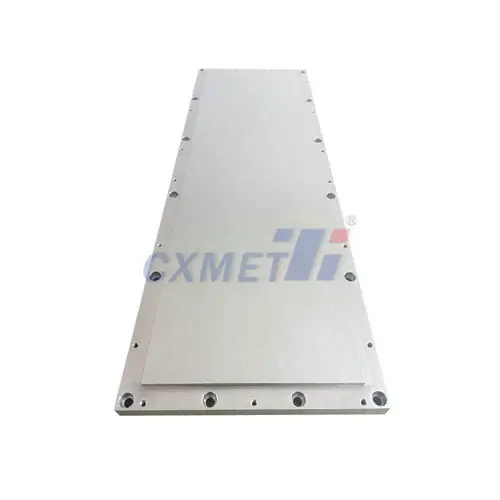

Define Your Titanium Plate Target Requirements and Compare Specifications
Start With Your Process and Equipment
Please make a note of how you will be using the Titanium Plate Target before you request a price. Deposition process, cathode model, target geometry, annual volume, and date of delivery, please. Semiconductor and optical lines normally need stricter impurity control than ornamental coating lines, and a prototype project may require just a few pieces. Drawings and cooling specifications allow a supplier to verify fit before cutting any metal. It also allows you to compare quotations from multiple mills side by side, which makes the evaluation time-efficient.
Look Past the Headline Purity
For a Sputtering Titanium Plate Target, the purity level is usually between 99.5% and 99.99%. The level is suitable for your film needs, contamination tolerances, and budget. Ask for a chemical analysis that includes oxygen, nitrogen, carbon, iron, and hydrogen. The presence of oxygen alone may alter the hardness and strength of titanium. Also check the grain structure. Steadier erosion, fewer particles, and hence less arcing are achieved with finer, uniform grains. And density matters too. Pure titanium is 4.51 g/cm³. Porous material may release trapped gas within a vacuum chamber. This is commonly dubbed a virtual leak.
Read the CXMET Titanium Plate Target Specifications
Here is a look at our product offering. This is a Gr1 Titanium Plate Target produced in China, with a width of 300 mm specified. Thickness: 0.5 - 100 mm; Width: 50 - 1000 mm; Length 】 50 - 2000 mm. Density is 4.51g/cm³. Surface treatments include polished and sandblasted. The listing displays Ti (min) of 99.99% and purity of >= 99.5%; please check the actual purity for your purchase with our staff. Standards: ISO 9001, ASTM B265. Processing services include bending, welding, decoiling, cutting, and punching.
Evaluate Dimensions, Bonding, and Manufacturing Control
Match Geometry and Tolerances to Your Cathode
The Titanium Plate Target must fit the cathode perfectly. Check: Length, breadth, thickness, flatness, parallelism, edge profile, hole location. Target plates are made for rectangular or planar cathodes; disk targets for circular systems. Poor flatness results in less contact with the cooling plate, slowing heat transmission and possibly causing localized overheating. Thickness also requires significance. Planar targets wear in a racetrack pattern; therefore, the utilization rate is frequently 20–30 %, and the lifetime of the target is defined by the beginning thickness. Always get tolerances in writing from each source before ordering.
Decide Between Bonded and Unbonded Designs
A bonded Titanium Plate Target, made by joining titanium to a copper backing plate, removes heat more quickly and is suited for high-power sputtering. For a monolithic, unbonded target, it works if the plate is thick enough for your clamp design and the power demand is minimal. If you select bonding, inquire about bond strength, void rates, and inspection procedure. Ultrasonic C-scan is a standard inspection, and many customers want a bonded area above 98%. Send us your cathode drawing and power range, and we will advise you on the solution that matches our processing services.
Check How the Supplier Controls Manufacturing
Verify Supplier’s manufacturing Controls. The manufacturing route is what delivers purity, density, and flatness. Typical route: selection of raw material, melting, forging or rolling, heat treatment, machining, surface finishing, cleaning, and packing. Ask about raw material traceability, tool cleanliness, cross-contamination measures, and storage conditions. Request chemical composition, size, surface condition, density, and lot identification information. CXMET has a 50,000 square meter site in China Titanium Valley and more than 80 skilled specialists; our product is in accordance with ASTM B265 and ISO 9001. Ask any supplier how targets are cleaned and packed to keep the surface oxidation-free.
Compare Titanium Plate Target Suppliers and Buyer Fit
Separate Manufacturers From Resellers
If you are comparing a Titanium Plate Target maker with a trading firm, you should be looking at technical expertise and management of the supply chain. Learn about their in-house cutting and machining, manufacturing capacity, small batch flexibility, ability to provide urgent replacements, and consistency on recurring orders. Then answer the questions. Send a technical inquiry concerning purity selection or cooling during the quote stage. Clear and accurate answers often indicate strong post-sale service. CXMET manufactures titanium, nickel, tantalum, niobium, tungsten, molybdenum, zirconium, and their alloys. So if you are an engineer who needs more than one metal, you may work with one team.
Match Capabilities to Your Industry
Different sectors rate suppliers differently. Semiconductor and precision coating customers need tight control of impurities, lot-to-lot uniformity, and extensive certifications of analysis. Decorative and wear-resistant coating lines are worried about consistent performance and speedy replacement. Optical and solar manufacturers concentrate on surface quality and particle control. Aerospace and medical purchasers require traceability and audit-ready records. We serve maritime, petroleum, chemical, power metallurgy, medicinal, electronics, vacuum, and coating users. Titanium is resistant to saltwater, chlorides, and many industrial chemicals, and is used in marine and chemical processing equipment.
Review Export Documents and Communication
Paperwork must be confirmed by the U.S. buyer prior to first shipment. Request material certifications, ISO certification, export documentation, and RoHS or REACH declarations where required. Get lead time in writing and confirm packing technique for ocean or air freight. Also, take note of reaction speed. Our support staff answers product questions, technical questions, and problems and may even give tailored technical assistance for special applications. Fast and accurate replies while quoting provide you a glimpse into how a supplier will respond when you have an issue on your line.
Compare Price, Quotation, and Total Cost
Know What Drives Titanium Plate Target Price
The pricing of Titanium Plate Target is based on purity, size, weight, machining complexity, backing plate material, testing, order quantity, packing, and delivery conditions. “Price per kilogram can be misleading on its own. A huge plate, with precise flatness and a polished finish, needs more labor than a basic cut piece; thus, the two should not be priced at the same cost. Higher purity costs more. It makes sense for sensitive semiconductor or optical operations, but a less demanding industrial line may not. Match purity to your process, and you are not paying for specs you cannot utilize.
Count Costs Beyond the Quote
A proper comparison would include freight, insurance, duties, installation, life, frequency of replacement, and down time. It should also include the cost of coating faults and rework. A cheaper target that arcs or loses particles or has to be replaced early may halt a line, and a few hours of lost productivity generally outweighs the savings on the purchase order. Track these figures via numerous goal revisions. After a few cycles, you will notice who provides you the lowest cost per completed product, not necessarily the lowest invoice.
Request Quotes You Can Compare
Ask each provider for the same thing. The whole quotation includes: composition, tolerances, surface finish, bonding details, Incoterms, lead time, payment conditions, warranty, inspection papers, packing. Missing goods are a warning indicator; they typically lead to additional costs later. At CXMET, we try to provide clear bids and competitive pricing and welcome queries on any line item. We can produce a Titanium Plate Target in a bespoke size within our stated ranges; just email us a sketch, and we will reply with a full quotation.
Verify Your Titanium Plate Target Supplier With a Checklist and Trial Order
Use a Three-Part Checklist
A checklist avoids misunderstandings. Technical inspections include purity, composition, dimensions, tolerances, surface polish, flatness, inspection records, and equipment fit. Commercial checks include bid thoroughness, minimum order quantity, lead time, payment terms, Incoterms and warranty. Supply checks comprise raw material traceability, manufacturing capacity, contingency plans, certifications, references, and process for non-conforming goods. Rate each provider in each category from one to five. The figures also make it simpler to explain your final selection to your buying and engineering teams.
Run a Sample or Trial Order
For crucial applications, request a sample before you sign off on a supplier. Installation fit, plasma stability, deposition rate, particle behavior, film homogeneity, and use rate should be evaluated by trial. Dark patches or nodules on the surface are commonly due to target poisoning by reactive gases like nitrogen or oxygen. A change in voltage or gas flow may assist. Record all results. These data represent your standard for next orders. They reveal whether a lot of Titanium Plate Target behaves the same way lot to lot.
Set Terms for Long-Term Supply
Once the trial is successful, put the terms forth in an agreement. Define inspection criteria, traceability, predictions, delivery schedules, pricing evaluations, and actions for non-conforming material. Provide your prediction early so the supplier can prepare for raw materials. CXMET has been developing for over 20 years, with an emphasis on foreign markets and innovative product development, and has established long-term relationships with integrity and stable service. Generally, if a supplier talks about these conditions publicly, it’s because they’ll treat every consumer the same after the deal is done.
Conclusion
How to choose the finest Titanium Plate: The target supplier begins with a clear spec on the process, geometry, purity, and quantity. Purity should suit the application. Chemical analysis, grain structure, and density tell you whether the material will sputter uniformly. The dimensions, flatness, and bonded or unbonded choice must match the cathode. Manufacturing control and inspection records must verify whether quality will recur. The danger is reduced if the producer can provide straight technical answers and comprehensive export documents. “More than price per kilogram, it’s the total cost, including downtime, replacement frequency and rework,” says. These things make a good judgment of any Titanium Plate Target buy. A checklist, a trial order, and a signed long-term agreement.
FAQ
Which purity level should I request for a Titanium Plate Target?
Choose purity based on your process. Semiconductor and optical work often calls for higher purity, while many industrial coating lines run well on lower grades. Our listing shows ≥ 99.5% purity and Ti (min) of 99.99%, so confirm the exact value for your order.
Should I choose a bonded or unbonded target?
Choose bonded for high-power sputtering because heat leaves the target faster. Choose unbonded when the plate is thick enough for your clamp design and the power load is moderate.
What should my RFQ include?
Include the application, deposition method, equipment model, drawing, purity, quantity, inspection needs, delivery location, and required date. A complete request produces quotes you can compare line by line.
How can I verify a supplier before a large order?
Review certifications, material traceability, inspection reports, and export experience. Then place a sample order to check plasma stability, particle behavior, and film uniformity.
Choose CXMET as Your Titanium Plate Target Supplier
Send your drawing and requirements to CXMET at sales@cxmet.com, and our team will review your Titanium Plate Target needs. As an experienced Titanium Plate Target manufacturer in China Titanium Valley, we offer Gr1 plate in thicknesses from 0.5 mm to 100 mm, with cutting, bending, welding, decoiling, and punching services. We provide customized technical support and competitive pricing. Visit https://www.cxmet-tech.com/ to see our full range.
References
1. ASTM International, Standard Specification for Titanium and Titanium Alloy Strip, Sheet, and Plate (ASTM B265), 2020.
2. International Organization for Standardization, ISO 9001: Quality Management Systems — Requirements, 2015.
3. Leyens, C. and Peters, M. (eds.), Titanium and Titanium Alloys: Fundamentals and Applications, Wiley-VCH, 2003.
4. Froes, F.H. (ed.), Titanium: Physical Metallurgy, Processing, and Applications, ASM International, 2015.
5. Martin, P.M. (ed.), Handbook of Deposition Technologies for Films and Coatings, 3rd edition, William Andrew (Elsevier), 2010.
6. Mattox, D.M., Handbook of Physical Vapor Deposition (PVD) Processing, 2nd edition, William Andrew (Elsevier), 2010.