knowledges
Titanium Grade 4 Round Bar: Best Applications and Benefits
2026-11-18 16:57:09
Titanium Grade 4 Round Bar offers the highest strength among commercially pure titanium grades, with a minimum yield strength of 483 MPa. It also retains the corrosion resistance that makes titanium useful in seawater, chlorides, and oxidizing acids. The best applications include chemical processing equipment, marine and desalination hardware, power generation parts, aerospace fasteners, and medical components that call for an unalloyed material. Its main benefits are strength without Grade 5 alloying elements, a low density of 4.51 g/cm³, and long service life. I wrote this guide to help engineers and buyers in the United States match the grade to the job and specify it correctly.
|
|
|
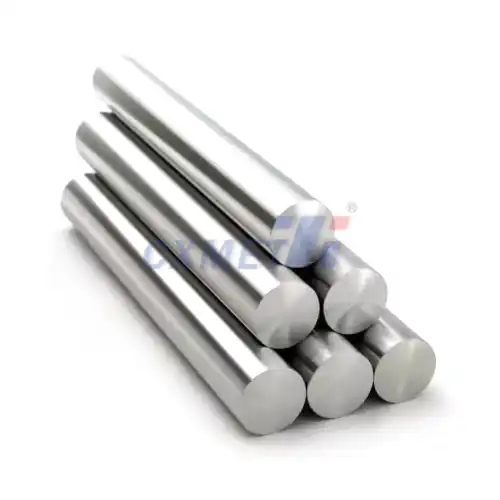

What Is Titanium Grade 4 Round Bar?
Definition, UNS R50700, and ASTM B348
That's the UNS R50700 number for Titanium Grade 4 Round Bar. It's a solid, cylinder-shaped item made from titanium that is commercially pure. It is made up of at least 98.6% titanium and has an alpha-phase structure. No alloying has been added. Most of its strength comes from iron and controlled air. Aluminum and vanadium are not significant. It's needed by many companies to meet ASTM B348 or ASME SB348, and it may also be needed for some aerospace projects. Before you buy, make sure you have written proof of the grade, material type, size, tolerances, condition, and paperwork. If a bar is in bad shape, it may fail the application even if it has the right grade.
Supply Conditions and Product Range
There are different ways that round bar can be shipped, and each way is good for a different next step. In general, a hot-worked bar can be used for cutting. It is easier to control the diameter of a bar that has been cold-worked, peeled, or ground. CXMET makes titanium bars through cold drawing, hot rolling, and forging. The bars come in round, square, hexagonal, and wire shapes. Standard Titanium Grade 4 Round Bar comes in widths of 6 mm to 250 mm and lengths of up to 6000 mm. To make the surface, you can polish, pickle, sand, or turn it. During the inquiry stage, our team checks your drawing to see if we need to make it in a different size.
Why Choose Grade 4 Over Grades 1 to 3?
Grades 1, 2, and 3 trade strength for being able to be shaped. Titanium Grade 4 Round Bar is an outlier. According to ASTM B348, Grade 2 needs a yield strength of at least 275 MPa. Grade 4 needs 483 MPa, which is about 75% more. Things that hold things in place, like rods, pins, bolts, and screws, work well with it. When you buy titanium in stores, it comes with a protective oxide film. A Titanium Grade 4 Round Bar still has this film. That strength means that it is less flexible and requires more forming force. Grade 2 might be better for parts that only need to be deep-formed and not hold weight, but the choice will depend on how it is used.
Titanium Grade 4 Round Bar Composition, Physical, and Mechanical Properties
Chemical Composition Limits
The balance of these elements is what makes titanium so useful. According to ASTM B348, Titanium Grade 4 Round Bar can't have more than 0.40% oxygen, 0.50% iron, 0.08% carbon, 0.05% nitrogen, and 0.015% hydrogen. The most each residual element can be is 0.1%, which adds up to 0.4%. Titanium metal is stronger because it has oxygen, nitrogen, and carbon between its atoms. They make things stiffer but stronger. Hydrogen needs to stay low so that things don't become weak. Iron makes things stronger. This value is what you should compare the mill test certificate to for each heat. This is because the heat number tells you something about how your Titanium Grade 4 Round Bar is made chemically.
Physical Properties and Weight Calculation
It has a density of 4.51 g/cm³, which is 43% less than austenitic stainless steel's density of 7.9 to 8.0 g/cm³. To plan freight, use this formula: weight per meter in kilograms equals 0.003542 times width in millimeters squared. A 50 mm bar weighs about 8.86 kg per meter, which means that a length of 6 m is about 53 kg. This metal expands at a rate of 8.6 µm/m·K, which is half as fast as 304 stainless steel. The heat stays close to the cutting edge or joint zone because it's not excellent at moving it. The food should be at 400°C for service.
Mechanical Properties and Fabrication
Tensile strength must be 550 MPa (80 ksi), and yield strength must be 483 MPa (70 ksi). It must also be able to stretch 15% and shrink 25%. That number isn't always useful because it depends on the diameter, state, and direction of the test. Instead, use the mill test document. CXMET can also do hardness, mechanical property, and ultrasonic tests if asked. Don't get galled in the shop. Use coolant, sharp tools, slow cutting speeds, and steady feed. There should be argon around you while you weld because pollution from oxygen, nitrogen, and hydrogen makes things harder and less flexible. To get rid of surface scale, it's best to leave extra space for cutting.
Best Applications for Titanium Grade 4 Round Bar
Chemical, Marine, and Desalination Service
The oxide sheet made from Titanium Grade 4 Round Bar is stable and doesn't react with saltwater, chlorides, oxidizing acids like nitric acid, or bleach when wet. Titanium Grade 4 Round Bar is cut by machines into parts for reactors, heat exchangers, and pressure vessel fittings. Parts for ships and gear for water lines are made from it by marine engineers. It is used to make electricity in the form of condenser and steam turbine parts, and it is also used to make structural rods and heat exchanger parts for desalination systems. First, check the amount and temperature. Hydrochloric acid, sulfuric acid, and other hot reducing acids can damage titanium that hasn't been alloyed. Furthermore, dry chlorine gas is very dangerous.
Aerospace and Medical Components
In the aerospace industry, Titanium Grade 4 Round Bar is used for structural fasteners, brackets, and fittings that need to be corrosion-proof but not as heavy as steel. Because it doesn't contain aluminum or vanadium like Grade 5, doctors use it to make bone screws, surgical tools, and orthopedic gadgets. But this stuff adds more paperwork. AMS 4921 and full heat traceability are often needed for work in the air and space. The standards for implants must be higher than ASTM B348. They must meet ASTM F67 or ISO 5832-2. Before you come, let us know if your project needs any special permissions, sanitation rules, or biocompatibility paperwork. That way, we can make sure we have what you need.
Custom-Machined Shafts, Pins, and Threaded Parts
Things like shafts, pins, bushings, screws, and threaded parts are all made with a round bar as their base shape. For these parts, Titanium Grade 4 Round Bar is a good choice because it has a low density and a minimum yield strength of 483 MPa. This makes it easier to handle and spin. Steel and titanium both have the same load, but titanium bends more than steel because it has a lower yield point. Check how stiff it is as well as how strong it is. Take a look at galvanic contact too. When it comes to steel or aluminum, titanium is often the cathode, which can make the other metal rust faster. CXMET is a company that can cut materials to the right length and machine parts that are ready to be put together.
Titanium Grade 4 Round Bar Compared with Alternative Materials
Against Grade 2 and Grade 5
The grades that are sold in the market are Grade 2 and Ti-6Al-4V (Grade 5). The Titanium Grade 4 Round Bar is in the middle. To meet ASTM B348, annealed Grade 5 bar needs to have a minimum yield of 825 MPa. This is a lot more than Grade 4. But it costs more to make and machine because it has aluminum and vanadium in it. Shape and weld Grade 2 steel better, and it costs less per kilogram. The most weight that it can hold, though, is 275 MPa. When you need more strength than Grade 2 but don't need alloying elements, you need Titanium Grade 4 Round Bar. Grade 5 stainless steel is the best choice when building strength is the most important thing.
Against Stainless Steel and Nickel Alloys
304L and 316L stainless steel are still cheap and easy to work with for everyday use. Cracks and chloride pitting are what make them weak in salt water and hot brines. Nickel alloys like Alloy 625 can handle more reducing acids, but they weigh 8.4 g/cm³ more and cost more per kilogram. The most important changes are shown in this table:
| Property | Ti Grade 4 | Ti Grade 2 | Ti Grade 5 | 316L |
|---|---|---|---|---|
| Min. yield (MPa) | 483 | 275 | ~825 | 170 (annealed) |
| Density (g/cm³) | 4.51 | 4.51 | 4.43 | ~8.0 |
| Seawater resistance | Very high | Very high | Very high | Pitting risk |
| Formability | Moderate | Good | Low | Good |
| Relative cost | Medium-high | Medium | High | Low |
When Grade 4 Is the Preferred Choice?
It's stronger than lower commercially pure grades, it doesn't rust, it's less dense than steel, and it can be machined into specific shapes. These are the four reasons why engineers choose Titanium Grade 4 Round Bar. These qualities can help it be lighter and last longer in places like boats, chemical plants, planes, and factories. You are never forced to make a choice. Use Grade 5 if you need structures that are stronger. Grade 2 is good for low-cost jobs that need to be done in a calm area. Load, environment, construction, rules, and lifecycle cost should all be taken into account. It's possible for a part that lasts longer and needs less maintenance to be worth the extra cost.
How to Choose and Buy Titanium Grade 4 Round Bar?
Define Service Conditions and Dimensions
Write down the working load, temperature, pressure, acidic medium, wear life, joining method, and how long the part is supposed to be used. It's then time to set the tolerances for size, length, roundness, straightness, surface finish, and cutting margin. Bar that has been hot-finished is best for heavy machining. Bar that has been cold-worked, peeled, or ground is best for parts that need to be very true. Buyers waste the most time by making two mistakes. There is no extra stock to get rid of when you order the exact finished diameter. You could also choose not to include the standard in the order.
Documents and Supplier Evaluation
Please ask for a mill test certificate with the heat number, inspection reports, proof that the goods are in line with the rules, and records of when they were shipped. The bar's heat number should match the certificate's heat number. Make sure the width, length, amount, heat number, and state of the real stock are right. You can compare makers, mills, distributors, and trade companies based on how well they can make, track, package, ship, and help with inspections. Since 2005, CXMET has been making metals that aren't iron. We have a 50,000-square-meter building in Shaanxi's "China Titanium Valley" where more than 80 experts help our clients.
Price, Stock, and Import Planning for US Buyers
Price per kg doesn't always show what's going on. The landed cost of Titanium Grade 4 Round Bar changes based on the type, size, state, tolerance, surface finish, tests, cutting, packing, freight, taxes, and Incoterms. Ask each supplier to list the costs of the materials, cutting, inspection, and packaging so that you can get fair quotes. Before you order something to be sent to the US, talk to your broker about the customs classification and country-of-origin proof. Then, include in your project schedule the time it takes to make, check, pack for export, and ship by air or sea.
Technical Inquiry Checklist for Titanium Grade 4 Round Bar
Technical Details
This will speed up the process of getting a quote. Here are the technical parts:
- Grade 4, UNS R50700, and the rules: AMS 4921, ASTM B348, or ASME SB348
- The kind of product: ground, forged, hot-rolled, cold-drawn, peeled, or forged
- Diameter, length, tolerance, and straightness
- End finish and state
- Time to machine the parts or a model of the finished product
Our engineers will check the Titanium Grade 4 Round Bar with your process to make sure it works before they give you a price.
Quality Requirements
Right away, figure out what proof you need. Here are some usual requests:
- Chemical testing and tensile strength tests, such as yield strength and elongation
- Hardness tests and visual inspections
- Sound wave tests and reports on measurements
- A third party to check if your customer asks for it
You can avoid having to check these things and delay shipping by putting them on the market early.
Commercial Terms
Add the business terms at the end of the question:
- The amount and where it's going
- The date and packing needed for export
- Terms of business and payment
- Papers that say where they came from
- How to make an insurance claim and mail it in
The sales and logistics teams can make a quote more quickly if the terms are clear.
Conclusion
The Titanium Grade 4 Round Bar is the best pure titanium option that is easy to find. When stretched, it can withstand 550 MPa of force. Its density is 4.51 g/cm³. ASTM B348 also says that it has to have a certain bending strength. It is stronger because it can't hold as much oxygen or iron. The oxide film also stops saltwater, chlorides, and base acids from passing through. For regulated work, you need higher standards than ASTM B348. These qualities are good for parts that are used in hospitals, ships, desalination plants, power plants, and chemical plants. It's stronger than Grade 2 and can hold more weight. It doesn't have any alloying elements like Grade 5. Even though it costs more than stainless steel, it is lighter, and chloride can't hurt it. The first things that go into a sound selection are service conditions, supply conditions, tolerances, and documents.
FAQ
What are the main uses of the titanium Grade 4 round bar?
This includes parts that are used to make chemicals, tools for desalination and naval use, parts that are used to make electricity, fasteners for airplanes, and medical devices like bone screws.
How does Grade 4 differ from Grade 2?
Titanium Grade 4 Round Bar has a minimum yield strength of 483 MPa, while Grade 2's is only 275 MPa. This is because Grade 4 has more oxygen and iron. Both are 4.51 g/cm³ dense, but Grade 2 is easy to shape.
When is titanium better than stainless steel?
Titanium works well in chloride, saltwater, and situations where it needs to be light. Stainless steel, on the other hand, can pit or add weight. Stainless steel usually costs less when it's warm outside.
Is ASTM B348 enough for work in medicine or space?
Not all the time. For example, AMS 4921, ASTM F67, traceability, or other things might need to be approved for these projects.
Request a quote for a titanium grade 4 round bar from CXMET
If you send your picture, service conditions, amount, location, and delivery date to sales@cxmet.com, our expert sales team will look them over. CXMET makes Titanium Grade 4 Round Bars in Shaanxi, China. They can make them in any size, cut them to length, test them, machine them, and pack them up to send abroad. Go to https://www.cxmet-tech.com/ to learn more about the product and get a quote right away.
References
1. ASTM International, ASTM B348/B348M: Standard Specification for Titanium and Titanium Alloy Bars and Billets, 2019.
2. ASTM International, ASTM F67: Standard Specification for Unalloyed Titanium, for Surgical Implant Applications (UNS R50250, UNS R50400, UNS R50550, UNS R50700), 2013.
3. ASM International, Materials Properties Handbook: Titanium Alloys, 1994.
4. ASM International, Titanium: A Technical Guide, 2nd Edition, 2000.
5. Springer, Titanium, 2nd Edition (Lütjering and Williams), 2007.
6. ASM International, ASM Handbook Volume 13: Corrosion, 1987.