knowledges
What Applications Require Reactive Sputtering with Hafnium Targets?
2026-05-13 10:04:03
Reactive sputtering with hafnium targets is used in fields that need very thin, high-performance hafnium sputtering target complex films to work in tough conditions. The hafnium sputtering target is very important for engineers who need to create layers of hafnium oxide or hafnium nitride while carefully controlling the stoichiometry and electrical qualities. During deposition, this method adds reactive gases like oxygen or nitrogen to the pressure room. This lets compound films form directly on surfaces. At Shaanxi CXMET, we've seen how this process changes the way semiconductors are made, optical systems work, and advanced sensor technologies work. It creates films that meet strict performance standards for gate dielectrics, anti-reflective coatings, and safe barriers in corrosive conditions.
|
|
|

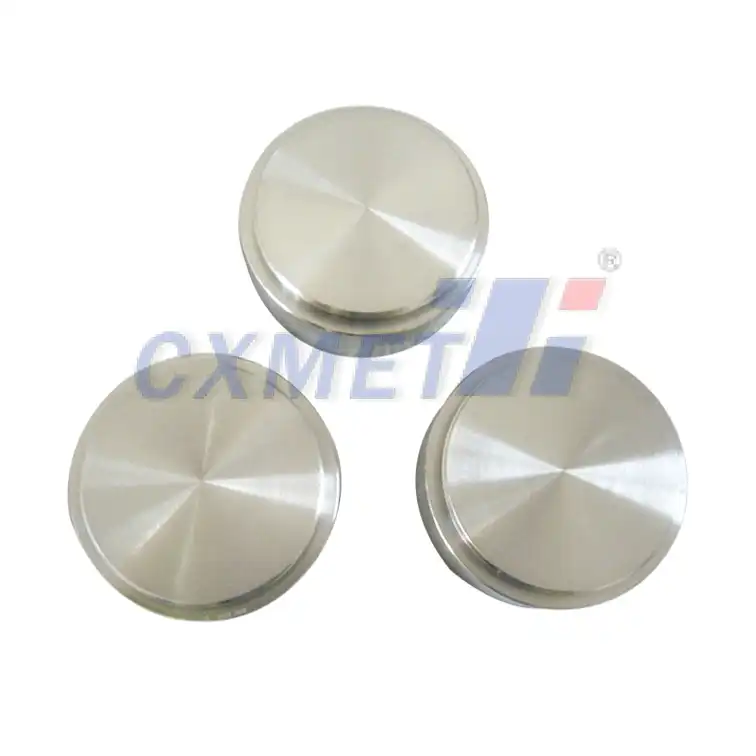
Understanding Reactive Sputtering with Hafnium Targets
The Fundamental Mechanism
In a controlled vacuum setting, reactive sputtering works by bombarding a hafnium target made of metal with energetic ions. Adding reactive gases to this attack causes chemical reactions on both the target surface and the substrate, which forms thin films of compounds. This is not the same as regular sputtering because the material that is formed is made up of more than just hafnium. Depending on the reacting gas used, it can also contain oxides, nitrides, or carbides.
Material Properties That Matter
At CXMET, our hafnium sputtering target units are kept at least 99.95% pure, which is very important for keeping them free of impurities that could damage the electrical qualities or visual clarity of the film. The density of 13.31 g/cm³ makes sure that the sputtering rate stays the same, and the melting point of 2,233°C keeps it stable when high-power deposition is used. Because hafnium has an electrical resistivity of 35.0 nΩ·m, it changes how objects react to DC or RF power sources when they are sputtering. Lower resistance makes it easier for energy to move, which keeps heat from building up and warping targets or changing the regularity of deposits. Its thermal conductivity of 23.0 W/m·K helps get rid of the heat that is made during ion bombardment, which extends the life of the target and keeps the process stable during long production runs. Due to its strong chemical stability, hafnium makes very sticky oxide layers when it comes into contact with oxygen plasma. Because of this, it is better than zirconium in situations where higher dielectric values are needed, but zirconium is cheaper for situations with less strict requirements. Metallic hafnium targets with reacting gases give better control over film stoichiometry during deposition, while hafnium oxide targets give ready-made compounds.
Vacuum Compatibility and Process Control
To keep impurities from mixing in too much, reactive sputtering needs vacuum levels that are usually less than 5×10⁻⁶ Torr base pressure. Our targets have a surface finish standard of Ra ≤ 0.8 µm, which lowers the risk of arcing and helps plasma form evenly across the face of the target. Customizable sizes can fit a range of sputtering system shapes, including those with spinning magnetrons or the flat cathodes that hafnium sputtering targets are popular in R&D settings.
Core Applications Requiring Reactive Sputtering with Hafnium Targets
Semiconductor Manufacturing and High-k Dielectrics
Hafnium oxide films are used as gate dielectrics in transistors below the 45nm technology node in modern integrated circuits. At these sizes, silicon dioxide dielectrics have too many leaky currents, so hafnium oxide's high dielectric constant (about 25 compared to silicon dioxide's 3.9) is needed. Controlling the oxygen partial pressure during reactive hafnium sputtering target deposition lets the film's stoichiometry be fine-tuned, which has a direct effect on the threshold voltage and leakage features of final devices. Dielectrics based on hafnium are also useful for capacitors used in DRAM memory units. How well the material works with silicon or metal conductors and how well it reacts to heat afterward determine the yield and dependability of the device. Our engineering team has helped several semiconductor factories find the best deposition settings to control the thickness to within a few nanometers and keep defect rates as low as possible.
Optical Coatings and Photonic Systems
Hafnium oxide films made by reactive sputtering are very clear at visible and near-infrared wavelengths. They also have a refractive index of about 2.0, which lets quarter-wave optical stack shapes be made. Precision optics, laser mirrors, and solar cells all have anti-reflective coatings that use alternate layers of hafnium oxide and lower-index materials to cut down on reflection losses. Reactively sprayed hafnium compounds are better than many polymer-based surfaces at resisting scratches and staying stable in harsh environments. This durability is important for optics in spacecraft and outdoor sensor screens that are exposed to particles that scratch or atmospheres that rust. Power density, substrate temperature, and oxygen flow rate are the deposition process parameters that determine film stress and binding strength. We change these parameters depending on the substrate material, which can be silicon, sapphire, or glass.
Advanced Sensors and MEMS Devices
Hafnium oxide is used as a passivation layer in microelectromechanical systems to keep sensitive devices safe from water and other contaminants. Hafnium oxide that has been properly formed is chemically inert, which means it will stay stable over time even in tough chemical environments like those found in equipment used to track oil and gas or make medicines. When the film microstructure is adjusted through reactive sputtering conditions, gas sensors that use hafnium oxide's ability to respond quickly to changes in oxygen partial pressure show short reaction times. The material's predictable thermal expansion coefficient and high mechanical strength make it useful for temperature monitors and pressure devices. Working with MEMS makers has taught us that controlling the target-to-substrate geometry and plasma spread is key to making films that are uniform across complicated three-dimensional structures.
Comparing Hafnium Sputtering Targets with Alternatives for Reactive Sputtering
Performance Against Titanium and Tantalum
Titanium targets are cheaper and spark faster, but titanium oxide films have lower dielectric constants (around 80–100 for the anatase phase) and are less stable at high temperatures than hafnium oxide films. Hafnium is a good material for semiconductors that need to work above 400°C because it doesn't crystallize, which would change their electrical qualities. The electrical performance of tantalum oxide is about the same, but it has higher leakage currents in very thin film ranges below 5nm. The difference in work function between tantalum oxide and common electrode materials has a different effect on hafnium sputtering target device threshold voltages than hafnium oxide. This means that straight replacement is not possible without redesigning the circuit.
Metallic Hafnium Versus Hafnium Oxide Targets
Depending on how flexible the process needs to be, you can use either solid hafnium with reactive gas or hafnium oxide targets that have already been made. Using metallic targets to change the amount of oxygen in a material allows for the creation of sub-stoichiometric films with controlled oxygen gaps that are used as dopants in resistive switching memory devices. Having this much freedom makes it harder to keep reactive gas flow controls and plasma monitoring devices steady. Hafnium oxide targets make process control easier for users that need fully stoichiometric films, but they need RF power sources because the material is an insulator. The hafnium sputtering target application rate is different for oxide and metal forms, which has an impact on the long-term costs of operations. Our procurement advisors help clients weigh these pros and cons based on output numbers and the range of film properties that are acceptable.
Real-World Performance Improvements
When a major optoelectronics company switched from using a competitor's lower-quality material to our high-purity hafnium targets, covering failure rates dropped by 40%. The improvement came from making fewer particles and keeping the plasma conditions more stable during long formation runs. In another case, an OEM of semiconductor equipment improved the thickness consistency across 300 mm wafers by 15% by working with our expert team to improve the goal geometry.
Procurement and Supply Chain Insights for Hafnium Sputtering Targets
Supplier Qualifications and Certifications
Reliable providers use ISO 9001 quality management systems and give certificates for materials that show their physical features, purity levels, and trace element content. Our factory in Shaanxi Province is regularly checked to make sure that the process controls that make sure stability from batch to batch are working properly. Customers should ask for test data samples and background checks from clients who have used similar applications before.
Bulk Purchasing and Logistics Strategies
Lead times for normal disc or plate targets are usually between four and six weeks, but they can be up to eight weeks for special shapes or bonding assemblies. As a backup, we keep a stock of popular sizes to meet pressing needs, especially those from R&D labs that need to make prototypes quickly. Costs can be cut by 15-20% compared to single-unit prices when volume agreements are spread out over multiple shipments. Purchasing managers should compare the costs of keeping goods with these savings, taking into account how much they want to store and how fast they want to use it. To keep things clean during foreign shipping, our cleanroom packing routine uses anti-static protection, moisture-proof outer cases, and vacuum-sealed polyethylene bags. The chance of transit damage goes up with goal size and weight. For packages with targets bigger than 300 mm in diameter, we suggest freight insurance and instructions for careful handling. Shipping multiple targets at once or combining orders with other refractory metal goods lowers the cost of handling per unit while still meeting safety standards for packing.
Market Dynamics and Negotiation Approaches
Zirconium ore markets affect the price of hafnium because hafnium is removed as a result of processing zirconium. Prices have been changing between 15 and 25 percent a year over the past few years, which is why long-term supply deals are appealing to people who buy a lot. We offer price protection contracts to customers who agree to buy above certain yearly amounts. This gives budget predictability, which is important for financial planning teams. Having technical help along with the hafnium sputtering target supply is more valuable than just the unit price. Our metallurgists help with casting problems, target bonding suggestions, and lifetime optimization plans that make targets last longer and have less downtime. When comparing sources whose product specs look the same on paper, these services help you tell them apart.
Best Practices for Using and Maintaining Hafnium Sputtering Targets
Optimizing Deposition Parameters
For reactive sputtering with hafnium, power density settings between 2 and 5 W/cm² work best, but exact numbers rely on how well you want to cool the target material and how fast you want to deposit it. For flat magnetron setups, substrate-to-target lengths of 50 to 100 mm balance the rate of deposition against the regularity of the film. We suggest starting with low power levels and slowly raising them while keeping an eye on the target temperature to avoid burning, which speeds up the degradation of the target. Reactive gas flow rates are very important for figuring out film stoichiometry. For hafnium oxide formation, oxygen flows usually make up 5 to 20 percent of the total gas flow (oxygen plus argon). The exact amounts are found by watching the plasma with optical emission spectroscopy. In reactive sputtering, hysteresis effects can cause sudden changes on the target surface between metallic and oxide modes. This means that the process needs to be carefully tuned to keep running smoothly in the transition region where deposition hafnium sputtering target rates are highest.
Handling and Contamination Prevention
To keep the surface from oxidizing or absorbing moisture, targets should stay in their vacuum-sealed package until they are installed. Our anti-static boxes and ESD-safe handling procedures keep particles from sticking together while they are being moved to the sputtering room. Wearing gloves and safe clothes keeps skin oils and particles from getting on target surfaces, where they would become flaws in the films that are being formed. Before adding substrates, pre-sputtering processes clean target surfaces by exposing them to argon plasma. This gets rid of any surface contaminants that gathered during installation. Depending on the target experience and chamber base pressure, this conditioning step can last anywhere from 10 to 30 minutes. During this cleaning phase and mode changes when reactive gas flows are changed, shutter devices keep the surfaces safe.
Lifecycle Extension and Inspection Protocols
The hafnium sputtering target utilization rate depends on the design of the magnetron, but it usually uses 20–40% of the target material before erosion patterns stop even deposition. By measuring the depth of the weathering gap on a regular basis, you can guess when the film will reach its end of life before the quality starts to decline. For some uses, partly used targets can be re-machined to make the sides flat, which increases their usefulness to 50–60% of the original material. Visual checks done once a month look for arcing damage or the growth of nodules that could lead to particle loss. Cleaning with isopropyl alcohol and lint-free wipes can get rid of deposits that are only loosely stuck on, but rough mechanical cleaning could damage the surfaces being cleaned. We help maintenance teams avoid sudden production stops caused by reduced targets by giving them advice on when to replace things based on how much they usually use for different types of applications.
Conclusion
Reactive sputtering with hafnium targets meets important goals in the optical, electronic, and sensor industries, where the performance of materials has a direct effect on how well devices work. This method is essential for making high-k dielectrics, protective coatings, and specialized electronic parts because it can exactly control the film's makeup and qualities. Our experience at CXMET shows that success relies on three things: the quality of the goal materials, the efficiency of the process, and the dependability of the supply chain. It's helpful for procurement teams to know the pros and cons of both metals and oxide targets, to look at a supplier's skills in more than just price, and to use best practices that make the best use of targets. More and more uses are being found for reactive sputtering because new technologies need smaller, more regular films with stricter property requirements. Only reactive sputtering can consistently meet these needs.
FAQ
1. What purity level is required for semiconductor-grade hafnium targets?
For semiconductor uses, purity levels must be at least 99.95% to avoid contamination that changes the electrical qualities. Our goals are in line with this requirement, and confirmed trace element analysis shows that the amounts of impurities are below the critical levels needed for silicon devices to work together.
2. How does reactive sputtering differ from non-reactive sputtering with hafnium?
Using only neutral argon gas, non-reactive sputtering creates thin films of pure metallic hafnium. During reactive sputtering, gases like oxygen, nitrogen, or others are added. These gases react chemically with the sputtered hafnium atoms, creating films of compounds like hafnium oxide or hafnium nitride while they are being deposited. This makes it possible to use insulating and protective coatings in ways that would not be possible with solid films.
3. What are typical lead times for custom hafnium target orders?
It takes four to six weeks to ship standard shapes, but six to eight weeks to ship unique designs or bonded parts. We keep a stock of popular sizes so that we can deliver quickly on urgent requests, especially those that help with R&D timelines.
Partner with CXMET for Superior Hafnium Sputtering Target Solutions
We at Shaanxi CXMET Technology Co., Ltd. have been making hard metals for 20 years, which makes us a reliable source for your hafnium sputtering target units. We offer certified materials with a minimum purity level of 99.95%, dimensions that can be changed, and skilled technical support that can help you with your unique deposition problems. Our cleanroom packing and strict quality control make sure that your targets come ready to be used right away in production. Our low prices and bulk discount programs help you get the most for your money when you buy from us. Email our expert team at sales@cxmet.com to talk about your application needs, get more information, or get a personalized price. We give you the reliable materials and teamwork that your important thin-film processes need.
References
1. Handbook of Thin Film Deposition Processes and Techniques: Principles, Methods, Equipment and Applications, edited by Krishna Seshan, William Andrew Publishing, 2012.
2. Materials Science of Thin Films: Deposition and Structure, Milton Ohring, Academic Press, 2001.
3. High-k Gate Dielectrics for CMOS Technology, edited by Gang He and Zhaoqi Sun, Wiley-VCH, 2012.
4. Reactive Sputter Deposition, Diederik Depla and Stijn Mahieu, Springer Series in Materials Science, 2008.
5. Hafnium and Hafnium Compounds in Kirk-Othmer Encyclopedia of Chemical Technology, Wiley Online Library, 2018.
6. Thin Film Materials: Stress, Defect Formation and Surface Evolution, L.B. Freund and S. Suresh, Cambridge University Press, 2004.