knowledges
What Standards Apply to Titanium 6Al-4V Grade 5 Round Bar Quality?
2025-11-27 15:27:12
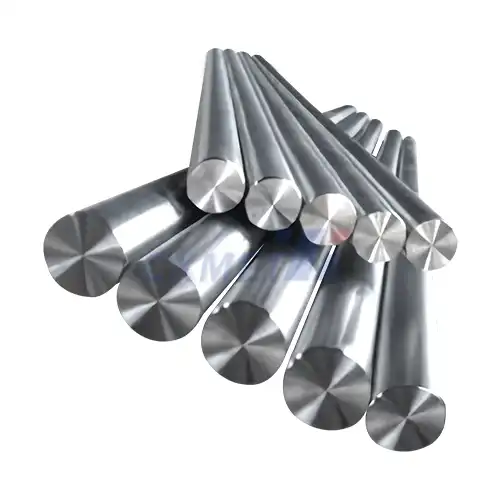
Ti-6Al-4V Grade 5 Round Bar is a very useful metal that is used in lots of different areas because it has great properties. As the need for this material grows, it is very important to know the quality standards that govern its production and use. If you follow these rules, all of your programs will be safe, regular, and dependable. Titanium 6Al-4V Grade 5 Round Bar quality standards cover the make-up of the material, its technical properties, and the ways it was made. This blog post will talk about these rules. As we talk, we'll talk about both international standards like ASTM, AMS, and ISO, and the goals of your business. Firms that make things, experts, and people who use them should all know these rules so they can work with good products that follow the rules and help them reach their goals.
|
|
|

What are the Key Material Properties of Titanium 6Al-4V Grade 5 Round Bar?
Chemical Composition
The unique features of titanium 6Al-4V Grade 5 Round Bar come from the way its elements are mixed. Most of the time, the metal is made up of titanium, 6% aluminum, and 4% vanadium. This arrangement is carefully managed to make sure that it always works well. The ASTM B348 standard says what levels of each element are allowed. This includes minor elements like oxygen, carbon, and iron. Keeping the right chemical makeup is very important because it has a direct effect on the mechanical qualities and resistance to rusting of the material. To make high-quality Titanium 6Al-4V Grade 5 Round Bar that meets industry standards, manufacturers must follow these strict chemical rules.
Mechanical Properties
Ti-6Al-4V Grade 5 Round Bar is very useful in many situations because of its mechanical qualities. Some of these qualities are hardness, stretch, tensile strength, and yield strength. ASTM guidelines say that Grade 5 titanium should have a tensile strength of at least 895 MPa and a yield strength of at least 828 MPa. The material should also be able to stretch no more than 10% and be hard between 36 and 39 HRC. Because it has these qualities, the round bar can stand up to high pressures and keep its shape in harsh conditions. To make sure that every batch of Titanium 6Al-4V Grade 5 Round Bar meets these mechanical property standards, it needs to be tested and quality controlled on a regular basis.
Microstructure
Titanium 6Al-4V Grade 5 Round Bar's substructure is a very important part of how well it works generally. The metal usually has an alpha-beta lattice, which helps make it strong and flexible at the same time. The heat treatment method changes the microstructure, and it is possible to change the microstructure to get the best qualities for different uses. ASTM standards tell us what kinds of microstructures are allowed, such as the size of the grains and how they are distributed in the material. To study and control the microstructure of Titanium 6Al-4V Grade 5 Round Bar, manufacturers use different methods, such as optical microscopy and electron microscopy. A well-managed nanoscale makes sure that the mechanical qualities and efficiency of the whole batch of material are the same.
How are Manufacturing Processes Controlled for Titanium 6Al-4V Grade 5 Round Bar?
Melting and Forging
To make high-quality Titanium 6Al-4V Grade 5 Round Bar, the melting and shaping processes must be carefully managed. Vacuum arc remelting (VAR) is often used to ensure that the makeup is uniform and that flaws are kept to a minimum. To keep things clean, the melting process has to follow strict rules for temperature and air quality. Forging helps smooth out the grain structure and improves the material's mechanical qualities after it has been melted. To get the granularity that is wanted, the forging process is usually done at certain temperature ranges and at controlled bending rates. The quality of the Titanium 6Al-4V Grade 5 Round Bar depends on these first steps in the production process, which must meet standards like AMS 4928 for aircraft uses.
Heat Treatment
Heat treatment is an important part of making Titanium 6Al-4V Grade 5 Round Bar because it changes the material's qualities in a big way. Solution cleaning and aging steps are often part of the heat treatment process. Solution treatment is done at temperatures above the beta transus, which is generally around 955°C. This is followed by quick cooling. This makes a solid solution that is too saturated. After that, the material is aged, which is usually done at temperatures between 480°C and 595°C. This lets fine alpha particles settle down in a controlled way, which makes the material stronger. The exact factors for heat treatment are often changed to fit the needs of different uses, and they have to meet standards like AMS 2801 for heat treatment of titanium metals.
Surface Finishing and Inspection
Finishing the surface and a careful check are the last steps in making the Titanium 6Al-4V Grade 5 Round Bar. To get the right surface hardness and size limits, surface finishing can include steps like grinding, sanding, or chemical milling. To keep the surface from getting flaws or being contaminated, these processes must be carefully managed. To find any surface or deep flaws, inspection methods like ultrasound testing, eddy current testing, and eye inspection are used. Dimensional checks make sure that the round bars are within the allowed ranges for width and straightness. To ensure the best quality of the end product, all checking methods must follow the right standards. For example, ASTM E2375 for ultrasonic testing of titanium alloys.
What Quality Control Measures are Essential for Titanium 6Al-4V Grade 5 Round Bar?
Material Certification
Material approval is a very important part of making sure that the Titanium 6Al-4V Grade 5 Round Bar is of high quality. There should be either a certificate of conformance (CoC) or a material test record (MTR) for each batch of material that shows it meets the standards. Usually, these papers have data on the material's chemical makeup, its mechanical qualities, how it was heated, and the outcomes of different tests that were done on it. Third-party testing labs are often used in the licensing process to make sure it is fair and correct. For example, EN 10204 tells us what kinds of inspection reports are needed for Titanium 6Al-4V Grade 5 Round Bar and other metal goods. Material approval is important for tracking and making sure the material meets the requirements for the purpose it was made for.
Non-Destructive Testing
A very important part of making sure the quality and stability of Titanium 6Al-4V Grade 5 Round Bar is non-destructive testing (NDT). Different NDT methods are used to find flaws on the surface and below the surface without harming the material. Ultrasonic testing is often used to find problems inside a material, like holes or gaps. Surface and near-surface flaws can be found with eddy current testing, while surface-breaking flaws can be found with dye penetrant testing. Magnetic particle screening isn't used very often on titanium metals, but it can be useful in some situations. It is important to follow the right guidelines when using these NDT methods, like ASTM E1417 for liquid penetrant testing or ASTM E2375 for ultrasonic testing of metal goods. These tests are very important for making sure that the Titanium 6Al-4V Grade 5 Round Bar meets the high-quality standards of fields like aircraft and medical implants.
Statistical Process Control
Statistical Process Control (SPC) is a way to make sure that Titanium 6Al-4V Grade 5 Round Bar always has the same quality. Statistical process control (SPC) is a way to always keep an eye on and manage business processes. Chemical makeup, dynamic properties, and physical features are some of the most important factors that are tested and studied on a regular basis to look for trends or changes that could affect the quality of the product. People often use control charts to check how stable a process is and spot any times when it is no longer under control. Companies that use SPC can find and fix problems before they make products that don't meet norms. In the aerospace industry, rules like ISO 9001 and AS9100 stress how important it is to keep processes under control with scientific methods. Businesses can be sure that their Titanium 6Al-4V Grade 5 Round Bar always meets or beats quality standards by using SPC. There will be less difference, which will make people happy.
Conclusion
In conclusion, the quality standards for Titanium 6Al-4V Grade 5 Round Bar are comprehensive and stringent, covering every aspect from material composition to final inspection. These standards ensure that the material consistently meets the high-performance requirements of critical applications in aerospace, medical, and industrial sectors. By adhering to these standards and implementing robust quality control measures, manufacturers can produce Titanium 6Al-4V Grade 5 Round Bar that is reliable, safe, and fit for purpose. As technology advances and applications evolve, these standards will continue to be refined, maintaining the material's position as a crucial component in high-performance engineering solutions.
For high-quality Titanium 6Al-4V Grade 5 Round Bar that meets or exceeds industry standards, consider Shaanxi CXMET Technology Co., Ltd. Located in China's Titanium Valley, we specialize in producing premium titanium alloys and other non-ferrous metals. Our commitment to integrity, innovation, and customer satisfaction ensures that you receive products of the highest quality. With our experienced team and state-of-the-art facilities, we can provide customized solutions to meet your specific requirements. For more information or to discuss your titanium needs, please contact us at sales@cxmet.com.
FAQ
Q: What is the typical tensile strength of Titanium 6Al-4V Grade 5 Round Bar?
A: Titanium 6Al-4V Grade 5 Round Bar typically has a minimum tensile strength of 895 MPa.
Q: What industries commonly use Titanium 6Al-4V Grade 5 Round Bar?
A: It is widely used in aerospace, medical, marine, and industrial applications due to its excellent properties.
Q: How is the chemical composition of Titanium 6Al-4V Grade 5 Round Bar verified?
A: Chemical composition is verified through material testing and provided in material test reports or certificates of conformance.
Q: What heat treatment processes are typically applied to Titanium 6Al-4V Grade 5 Round Bar?
A: The material usually undergoes solution treating and aging processes to optimize its mechanical properties.
References
1. ASTM B348 - Standard Specification for Titanium and Titanium Alloy Bars and Billets
2. AMS 4928 - Titanium Alloy Bars, Wire, Forgings, and Rings 6Al-4V Annealed
3. ISO 5832-3 - Implants for surgery — Metallic materials — Part 3: Wrought titanium 6-aluminium 4-vanadium alloy
4. ASTM E2375 - Standard Practice for Ultrasonic Testing of Wrought Products
5. AMS 2801 - Heat Treatment of Titanium Alloy Parts
6. EN 10204 - Metallic Products - Types of Inspection Documents