knowledges
What Welding or Joining Practices Suit a Niobium Bar?
2026-08-07 16:28:02
Welding common metals is a distinct process from joining a niobium bar to other components. Niobium has a melting point of above 2400°C and is very susceptible to ambient contamination. The heat input and environment must be strictly controlled to maintain the purity essential to niobium's usefulness. This article discusses why electron beam welding is still the industry standard for a niobium bar, but a practical alternative may be done using TIG welding; and how niobium bar stock is linked to other metals in real-world assemblies.
|
|
|
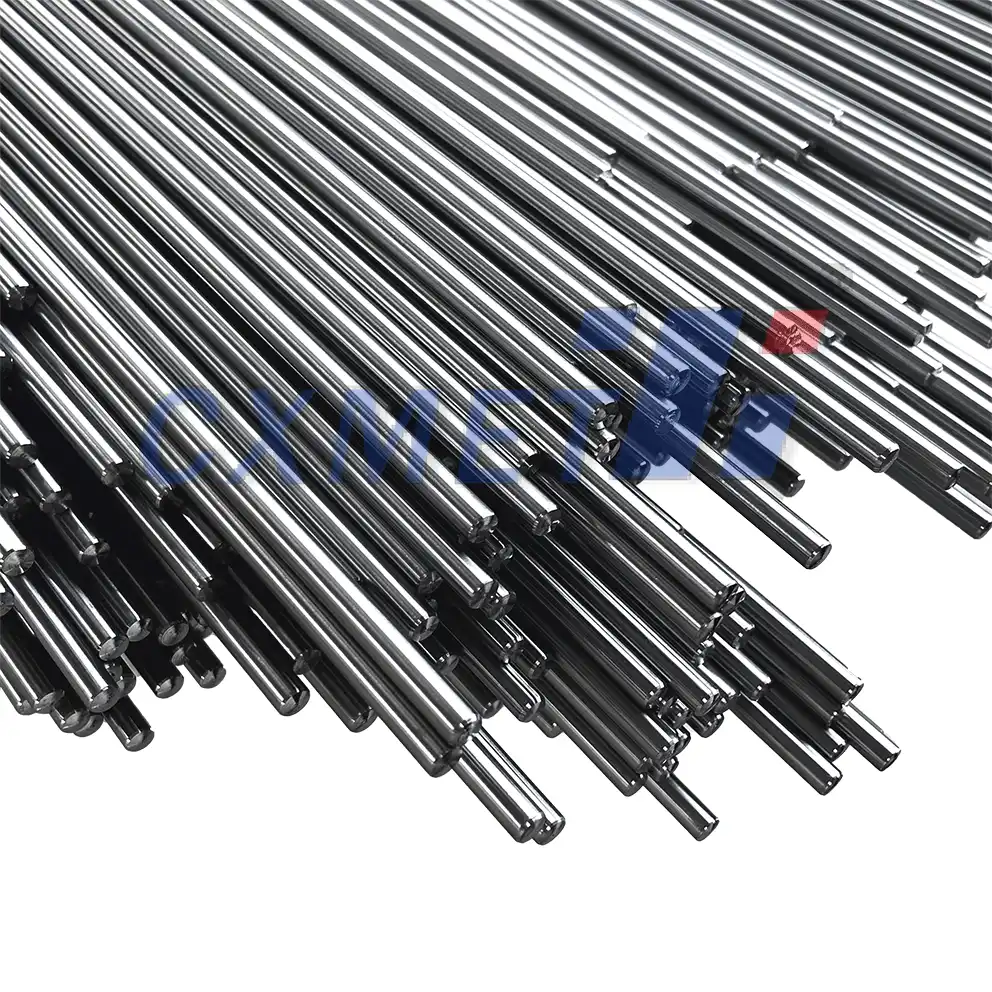

Why Is Electron Beam Welding the Preferred Method for a Niobium Bar?
Why Does a Niobium Bar Require a Vacuum Welding Environment?
Niobium is very reactive with oxygen, nitrogen, and hydrogen at extreme temperatures, and any absorption of these interstitial elements during welding will dramatically damage the mechanical and superconducting characteristics of the material. This is why the joining of a niobium bar or sheet component is usually done inside a high vacuum chamber rather than in open air. Such work is usually required at vacuum levels of 10-5 to 10-6 mbar, as trace exposure to the atmosphere at welding temperatures might impart contamination that would never be detected by eye examination alone. This vacuum requirement is non-negotiable for fabricators of a niobium bar for high purity or superconducting applications, since it directly protects the residual resistivity ratio and mechanical integrity upon which the final component depends.
How Does Electron Beam Welding Preserve the Purity of a Niobium Bar?
Electron beam welding, or EBW, has become the main joining technique for niobium bar and sheet manufacturing since it occurs in the same high vacuum environment the material demands. Unlike arc-based techniques, EBW employs a concentrated stream of electrons to melt the joint, allowing for superior control over heat input and weld penetration while keeping the whole process insulated from ambient pollution. This combination is especially important for niobium bar components for superconducting RF applications where even a little drop in purity at a weld seam may noticeably restrict the possible performance of the entire assembly. EBW is the reference method for comparison of different niobium joining processes, since it always results in welds with low pickup of interstitials.
What Applications Rely on Electron Beam Welded Niobium Bar Components?
Superconducting cavity construction makes greatest use of electron beam welded niobium bar and sheet assemblies, joining high purity niobium components to make the precise resonator structures utilised in particle accelerators. Besides these specialised applications, EBW is used to weld niobium bar stock into transition joints, vacuum flanges and structural components for chemical processing and high-temperature furnace equipment where corrosion resistance and thermal stability of the material are particularly important. In these assemblies, a niobium bar is often used as the flange or end-connection stock, such that the performance of the completed part in vacuum or at high temperature is directly dependent on the quality of its weld joint. This is the reason why EBW is the default option when the application does not permit any compromise on the purity of the material.
Can a Niobium Bar Be TIG Welded Without Losing Purity?
What Precautions Are Needed When TIG Welding a Niobium Bar?
While electron beam welding remains the gold standard, TIG welding is sometimes considered for joining a niobium bar in less purity-critical applications, since it is significantly less expensive and more accessible than vacuum-chamber EBW equipment. However, conventional open-air TIG welding allows some level of atmospheric diffusion into the heated metal, which can compromise the very properties that make niobium desirable in demanding applications. Fabricators exploring TIG welding for a niobium bar must therefore take extra precautions, including welding inside a sealed inert-gas glovebox rather than relying on surface shielding alone, since niobium's reactivity at welding temperatures is even more pronounced than that of titanium or other reactive metals commonly joined by TIG.
How Does Inert Gas Shielding Protect a Niobium Bar During TIG Welding?
When TIG welding a niobium bar, it is vital to maintain a perfectly inert environment surrounding the weld pool to minimise contamination. The shielding gas is high-purity argon, and critical work, instead of torch-side gas coverage, is often done inside a purged glovebox chamber. Surface shielding alone has difficulty in fully excluding atmospheric gases from a reactive material such as niobium. The interstitial pick-up in TIG welded niobium bar joints tends to be somewhat greater than for their electron beam welded counterparts even with proper shielding, and therefore TIG welding is limited to situations where perfect purity is of lesser concern than cost or accessibility factors.
When Is TIG Welding a Practical Alternative for Niobium Bar Fabrication?
If the application is more concerned with structural joining than ultra-high purity, then TIG welding is a genuinely viable option for a niobium bar. Such applications might include general industrial fixtures, parts of furnaces that are not superconducting, or some chemical processing equipment where the corrosion resistance of niobium is more important than the interstitial content. In such cases, the cost and lead-time benefits of TIG welding, compared to arranging access to specialised vacuum EBW equipment, may justify a little loss of material purity. Fabricators considering TIG welding a niobium bar project should take care to consider the unique performance requirements of the completed assembly. Substituting TIG for EBW is suitable for certain applications, but not for high-purity or superconducting-grade work.
How Is a Niobium Bar Joined to Dissimilar Metals in Industrial Assemblies?
How Is a Niobium Bar Joined to Titanium or Stainless Steel Components?
Many industrial assemblies need a niobium bar to be linked not to another piece of niobium but to a dissimilar metal such as titanium or stainless steel, usually at flange or transition sections. These junctions are also often created using electron beam welding since the vacuum environment is good for both metals and offers perfect control over the fusion zone where two distinct materials meet. Since niobium expands with heat differently from many common structural metals, and it melts at a different temperature, the design of the joint and the welding process must be carefully adapted to prevent cracking or partial fusion at the interface. Dissimilar-metal connections, if made appropriately, enable the use of a niobium bar in larger systems where the corrosion resistance of the material may be combined with the structural or economic benefits of other metals elsewhere in the assembly.
Why Are Niobium-Titanium Alloy Transition Joints Used With Niobium Bar Assemblies?
A niobium bar (really an alloy of niobium and titanium, not pure niobium) is used in numerous precise applications, especially as transition stock for flanges and structural connections. This alloyed bar stock is tougher and mechanically stronger than pure niobium, making it better able to handle the strains of vacuum seals and bolted connections without deformation. It is common practice in accelerator engineering to use alloyed niobium for the transition sections and high purity niobium for the core functional components. This approach has the advantage that the designer can optimise the mechanical robustness and the material purity where they are most needed within the same assembly.
What Surface Preparation Steps Precede Joining a Niobium Bar?
Regardless of the welding process used, surface preparation is a critical factor for the quality of every niobium bar junction. Prior to welding, all components must be carefully cleaned and degreased and washed with ultra-pure water to eliminate oils, dust, and surface impurities. Any residue left at the joint interface might introduce flaws or trap contaminants during fusion. For important applications, this cleaning is done just before loading the pieces into the vacuum chamber under controlled circumstances to minimise the exposure of the newly cleaned niobium bar surface to ambient air. This meticulous preparatory practice is just as crucial to the final weld quality as the welding process itself.
Conclusion
Successfully joining a niobium bar depends on controlling atmospheric contamination, whether through electron beam welding, carefully shielded TIG welding, or well-designed transition joints. Shaanxi CXMET Technology Co., Ltd, founded in 2005 in China's Titanium Valley with over 80 technical staff, supplies high-purity niobium bar stock to exacting standards. For technical guidance or custom specifications, contact sales@cxmet.com — our team is ready to help.
References
1. "Studies of Alternative Techniques for Niobium Cavity Fabrication," Proceedings of the International Conference on RF Superconductivity.
2. "Superconducting Properties of Niobium after Electron Beam Welding," Physica C: Superconductivity.
3. "A New Method for Simulating Electron Beam Welding Process of Niobium Sheets with Beam Oscillation," Materials Research Express.
4. "ILC Reference Design Report, Volume 3: Accelerator," International Linear Collider Global Design Effort.
5. ASTM International, ASTM B393 Standard Specification for Niobium and Niobium Alloy Bar, Rod, and Wire.
6. ASTM International, ASTM F1341 Standard Specification for Unalloyed Niobium for Surgical Implant Applications.