knowledges
Why Choose Ti-13Nb-13Zr Titanium Rod for Medical Implants?
2026-11-05 17:02:32
We choose Ti-13Nb-13Zr Titanium Rod for medical implants when a project needs corrosion resistance, moderate stiffness, and a chemistry free of aluminum and vanadium. The alloy, covered by ASTM F1713, has an elastic modulus of roughly 79 to 84 GPa, compared with about 110 GPa for Ti-6Al-4V. That lower stiffness reduces stress shielding, and its passive oxide layer supports stable behavior in body fluids. In this guide, I explain the alloy, compare it with common options, list the data to verify, and show how procurement teams can qualify a supplier.
|
|
|

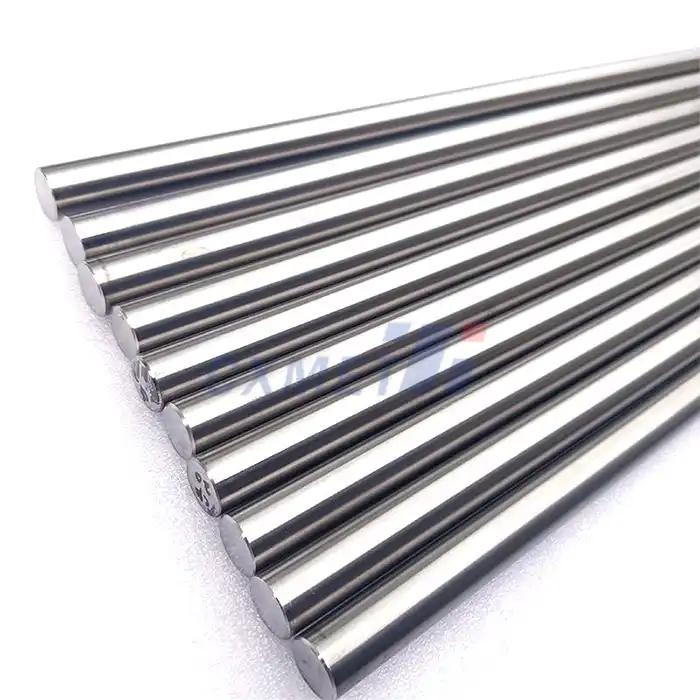
What Is a Ti-13Nb-13Zr Titanium Rod?
Composition and Alloy Basics
Ti-13Nb-13Zr Titanium rod is made of titanium that has about 13% zirconium and 13% niobium mixed in with it. Zirconium and niobium both make up 12 to 14% of our product sheet. It is okay for oxygen, iron, carbon, and nitrogen to stay within the limits set by the company. The alloy was made by Davidson and his friends in the 1990s as a low-modulus option for total hip replacement that would not rust. In Ti-6Al-4V, niobium and zirconium are used instead of aluminum and vanadium to keep the microstructure fixed. You shouldn't trust nominal values because oxygen changes how flexible something is. Instead, I tell buyers to ask for heat-level chemistry for each lot.
Standards and Product Form
ASTM F1713 is the main rule for medical implants that are made of wrought Ti-13Nb-13Zr. It's usually written down in orders from people in the US. If you want to get quotes, you should be clear about the diameter, length, production method, heat treatment state, and surface finish. In different places, rods and bars are called different names. There are items in our description for both Gr1 and Gr2 grades. Please ensure you are familiar with the exact name and standard before requesting a quote. A full offer should include scientific data, inspection records, heat numbers, chemical analysis, and full batch tracking. These are things that medical programs need for audits.
CXMET Product Specifications
Our Ti-13Nb-13Zr Titanium Rod is a round bar of titanium that has been cold-rolled. It is made in China by Shaanxi CXMET Technology Co., Ltd. Even though it's made of metal, it's not as dense as stainless steel, which is 8 g/cm³. You can order any length you want, from 6 mm to 200 mm. To make the surface, you can smooth, anneal, or sandblast it. Usually, the hardness is close to 320 HV, the elongation is 10 to 15%, and the tensile strength is between 850 and 950 MPa. The yield strength is also close to 850 MPa. You might want to compare these common ranges to the test report for your lot.
Why Ti-13Nb-13Zr Titanium Rod Is Considered for Medical Implants?
Corrosion Resistance in Body Fluids
It's critical that implants don't rust because they are kept for years in warm fluid that is high in salt. When oxygen comes in contact with titanium, it makes a thin layer of passive oxide very quickly. It stays stable thanks to niobium and zirconium. By stopping the release of metal ions, this film makes the material more biocompatible, which is why it is a good choice. Many of our clients already use titanium in tools for drugs, chemical processing, and ships because it doesn't react with salt. It's still important to know how the surface is. Because machining damage, iron contamination, and galvanic contact can make the film weaker, it is important to be careful when you clean and handle it. Tests for rust on the finished item are still the last step.
Lower Modulus and Stress Shielding
When bone doesn't receive enough stimulation, it can break down because it can't hold as much weight as the near bone. The stretchiness of Ti-13Nb-13Zr is between 79 and 84 GPa, and that of Ti-6Al-4V is around 110 GPa. This is what engineers call "stress shielding." In other words, Ti-6Al-4V is about 25% less stiff. Cortical bone isn't as strong as other bones—it has a strength of 10 to 30 GPa, which is much lower than metal. It doesn't matter what the modulus is; the load shift will still go in the right direction. This helps with designs that need to be easy to bend and strong when they're tired, like femur stems and intramedullary nails. Check the real thing because the shape and finish of the part affect how long it will last under stress.
Comparison with Ti-6Al-4V and Commercially Pure Titanium
Finding Ti-6Al-4V is easy. It has been used in medicine for a long time and works well mechanically. Aluminum and vanadium are used to make it, and the modulus is greater. Pure titanium that is sold in stores doesn't rust and is easy to shape, but it's not strong enough to hold weight. 850 to 950 MPa is the stress range for Ti-13Nb-13Zr Titanium Rod. It's not as stiff as Ti-6Al-4V and doesn't have any vanadium or aluminum in it. It's also harder to machine and doesn't have as much case history. For a comparison to be fair, both sides must use the same forms, heat treatments, sizes, test settings, and data that has been accepted.
Ti-13Nb-13Zr Titanium Rod Properties Engineers Should Verify
Chemistry and Microstructure
Before approving the Ti-13Nb-13Zr Titanium Rod, make sure you know the name of the alloy, the standard that applies, and the chemistry. The ICP-OES test makes sure that the amounts of niobium and zirconium are within the range given. The metal is also checked for oxygen and iron. Oxygen can make the metal less flexible, so the iron level should stay low. As per ASTM E3 and E407, a metal-imaging test shows that the structure is regular and there are no alpha cases or divisions. Ask for micrographs of the part while it is under cycle load to see how the grain size, inclusions, and phase consistency change as it wears down. AMS 2631 says that ultrasonic testing can find holes or other things inside a material that could make stress cracks form while it is being used. I believe these checks should be added to the order.
Mechanical Data
Tests that follow ASTM E8 have shown that the yield strength, final strength, and elongation are all correct. You can stretch it 10–15%, tension it to 950 MPa, and yield it to 850 MPa. It can also be hard to close to 320 HV. When something has been used for a while, it can reach yield strengths of over 800 MPa and tensile strengths of over 900 MPa. Something changes when it is heated because it changes the balance between being strong and getting soft. Remember to write down the oven, temperature, hold time, and cooling method for each batch. Ask the provider to separate the lab results that come with the minimum guarantee from the normal ones. The guarantee numbers are the only ones that should be used in a design calculation. For parts that hold weight, fatigue testing must still be done on the finished part.
Dimensions, Surface, and Traceability
It doesn't matter how strong the mechanical data is if the rod is dirty or out of limits when it arrives. You should list the tolerances for width, straightness, roundness, length accuracy, and surface finish in the RFQ. Each finish works best with a different set of steps after polishing, annealing, and sandblasting, so pick the one that fits your machine plan. Please compile a list of acceptable flaws and request the findings from the dimensional checks. There is a heat number for each rod, so the lot markings, mill test certificates, and records of the heat treatment should all match. During an audit or investigation of a complaint, that chain lets your quality team follow a finished part all the way back to the melt.
Manufacturing and Applications of Ti-13Nb-13Zr Titanium Rod
Production and Machining
Care must be taken when melting to start with quality. It is not possible for interstitial elements and particles to melt in a vacuum or a controlled atmosphere. After being forged and rolled, our Ti-13Nb-13Zr Titanium Rod is cold rolled to smooth out the grain and make it sound on the inside. By annealing, you can change how strong, flexible, and easy to work with something is. Because it sticks to things more than Ti-6Al-4V and titanium doesn't let heat pass through it well, this alloy needs to be cut with care. Use low cutting speeds, high feed rates, sharp tools, and lots of coolant to keep work from getting hard and galling. It keeps the surface safe from water, chloride residue, and iron transfer when the packaging is clean. We can make sure that the rod state works with your cutting method if you tell us about it early on.
Orthopedic and Trauma Uses
In orthopedics, this alloy is thought to be good for making intramedullary nails, screws, pins, fixation parts, spinal components, and femoral stems. The lower modulus in nails lets a split site move a little, which might help a callus grow. When you walk a million times, the hip and knee stems need to be strong enough to last. Oxygen diffusion hardening can make surfaces that move harder and less likely to wear down. People will still have to look at the loads, shape, surface treatment, biological tests, proof of sterilization, and regulatory review to decide if it is right. Extra care needs to be taken with parts that are likely to break, and this metal has not been used on people as much as Ti-6Al-4V. There is less qualification risk when the supplier of materials, the machinist, and the person who makes the gadget work together from the start.
Dental and Precision Components
Dental teams use small-diameter rods for implant posts and abutments because they are resistant to corrosion, have a good surface, and can be made to the right size. What really makes a difference is the treatment that is put on top of the device. The metal helps the bone grow on top of it. Because it is so light (4.5 g/cm³), it can also be used to make very precise medical parts. It is important to look at how long reused surgery tools last in terms of their hardness, wear, sterilization, and cleaning cycles. It is used not only in medicine but also for parts in the energy, marine, and chemical industries that are exposed to acids and chlorides. Our lists of products use up to 600°C. It means that the same qualified person can work on both the implant program and the industrial program.
How to Select a Ti-13Nb-13Zr Titanium Rod Supplier?
Supplier Capability and Documentation
Price or availability shouldn't affect the order. Make sure the supplier has experience with medical titanium, controlled melting, bar production, precise finishing, and keeping records for each batch. When a quality system is fully developed, it has ISO 9001 and, if needed, ISO 13485 certifications. However, a certificate from the seller does not guarantee the quality of your finished implant. In China's "Titanium Valley," Shaanxi CXMET Technology Co., Ltd. has been in business since 2005 and now covers 50,000 square meters and has more than 80 skilled workers. We work with metals like titanium, nickel, tantalum, niobium, tungsten, molybdenum, zirconium, and more than one of these. A few of the fields that use our products are medicine, electronics, vacuum, coating, oil and gas, chemicals, and power metallurgy.
Buying Checklist for RFQs
With a clear RFQ, you can get quotes faster. Describe the metal, its standard, its diameter, its length, its quantity, its tolerances, its surface finish, its straightness, its heat-treatment conditions, its chemical limits, its mechanical needs, its tests, its packaging, and its certificates. Before you order a Ti-13Nb-13Zr Titanium Rod, make sure you get a datasheet, a sample certificate from the mill test, heat-treatment records, measurement inspection results, and keep track of your order. When buying prototypes, people should find out the minimum order quantity, the lead time, the stock status, and the procedures for nonconformance. Laws, speed, paperwork, and the quality of the surface should be at the top of the list. Then, look at the arrival cost, the freight cost, the tax cost, and the machining return. A low price per kilogram isn't as appealing if having to throw away or try something again makes the cost per finished part go up.
When This Alloy Is the Right Choice?
Ti-13Nb-13Zr Titanium rod is the best niobium-zirconium titanium metal for your design because it doesn't rust, isn't as stiff as Ti-6Al-4V, and can be exactly made. Your team only needs to finish application-specific qualification for OEM projects that require special sizes and material that can be tracked to make it work. To get a better idea of a design, pay more attention to parts that are likely to break, heavy fatigue duty, and short lead times. You can change the sizes and tolerances, treat the surface, cut precisely, and obtain OEM support. We can also use heat treatments that match the properties you want. Don't just look at the ingredients; also consider the processed data, the way it is regulated, the availability of the product, and the total cost.
Conclusion
Some medical equipment can use Ti-13Nb-13Zr Titanium Rod because it doesn't rust, is hard (79 to 84 GPa), and doesn't have any aluminum or vanadium in it. Plus, it's not as strong as Ti-6Al-4V and doesn't have two of the undesirable alloying elements. However, it has a shorter clinical record and requires careful machining. It is stronger than pure titanium that is sold in stores when it comes to load-bearing designs. As per ASTM F1713 and other similar test methods, the choice of sound is based on the chemistry, microstructure, mechanical data, limits, and records of heat treatment. Still needs to be done on the finished device to show that it works for fatigue, surface condition, sterilization, and safety regulations. Not just makeup, but also checked facts will help you make the right choice.
FAQ
Is Ti-13Nb-13Zr harder to machine than Ti-6Al-4V?
Yes. Shops should use lots of coolant, sharp tools, slow cutting speeds, and fast feed rates because it sticks to things. These steps keep the work from getting too hard and the surface from galling.
Which standard applies to this alloy?
ASTM F1713 covers surgical implants made of wrought Ti-13Nb-13Zr. Due to changes in the type of product the client wants and the regulatory path, it is important to check the most current version and its scope.
Can the rod receive surface treatment?
Yes. Oxygen diffusion hardening makes the surface harder and less likely to wear down when it is used for articulating. You can also get finishes from CXMET, such as polished, annealed, and sandblasted. You can also treat the surface to make it less likely to rust.
Request a Ti-13Nb-13Zr Titanium Rod Quotation from CXMET.
Please send your drawings to sales@cxmet.com along with the diameter range, quantity, heat-treatment conditions, and testing needs so that our technical team can look at them quickly. CXMET is a company that sells Ti-13Nb-13Zr titanium rods. They have cold-rolled round bars that range in size from 6 mm to 200 mm. You can get OEM help and lengths that are made just for you. As soon as possible, before the design freeze, let us know about your project. That way, we can ensure we have all the tools and details we need. You can find out more about the product at https://www.cxmet-tech.com/.
References
1. ASTM International, 2021. ASTM F1713, Standard Specification for Wrought Titanium-13Niobium-13Zirconium Alloy for Surgical Implant Applications (UNS R58130).
2. Bio-Medical Materials and Engineering, 1994. "New Surface-Hardened, Low-Modulus, Corrosion-Resistant Ti-13Nb-13Zr Alloy for Total Hip Arthroplasty."
3. Progress in Materials Science, 2009. "Ti-Based Biomaterials, the Ultimate Choice for Orthopaedic Implants—A Review."
4. Journal of the Mechanical Behavior of Biomedical Materials, 2008. "Mechanical Biocompatibilities of Titanium Alloys for Biomedical Applications."
5. Biomaterials, 1998. "Titanium Alloys in Total Joint Replacement: A Materials Science Perspective."
6. ASTM International, 2016. ASTM E8/E8M, Standard Test Methods for Tension Testing of Metallic Materials.